Crash of a Douglas C-124C Globemaster II in Cape Newenham

Date & Time: Sep 8, 1972
Operator:
Registration:
51-0132
Flight Type:
Survivors:
Yes
MSN:
43466
YOM:
1951
Crew on board:
0
Crew fatalities:
Pax on board:
0
Pax fatalities:
Other fatalities:
Total fatalities:
0
Circumstances:
Upon landing at Cape Newenham Airport, the four engine airplane went out of control and veered off runway. It went down an embankment, lost its tail and came to rest. There were no casualties.

Crash of a Lockheed 18 LodeStar in Wales

Date & Time: Jul 7, 1972 at 1500 LT
Type of aircraft:
Operator:
Registration:
CF-BAL
Flight Phase:
Flight Type:
Survivors:
Yes
Schedule:
Wales - Wales
MSN:
2383
YOM:
1943
Location:
Crew on board:
2
Crew fatalities:
Pax on board:
0
Pax fatalities:
Other fatalities:
Total fatalities:
0
Captain / Total flying hours:
1700
Captain / Total hours on type:
45.00
Circumstances:
While taking off from the gravel runway at Wales-Lost River Mine Airport, the crew lost control of the airplane that veered off runway and collided with a large gravel pile before coming to rest. Both occupants were injured and the aircraft was damaged beyond repair.
Probable cause:
The pilot-in-command failed to maintain directional control for unknown reason.
Final Report:

Crash of a Pilatus PC-6/B1-H2 Turbo Porter in Deadhorse

Date & Time: Apr 19, 1972 at 1440 LT
Registration:
N3602R
Flight Phase:
Flight Type:
Survivors:
Yes
MSN:
2004
YOM:
1966
Crew on board:
1
Crew fatalities:
Pax on board:
0
Pax fatalities:
Other fatalities:
Total fatalities:
0
Captain / Total flying hours:
8500
Captain / Total hours on type:
1200.00
Circumstances:
Shortly after takeoff from Deadhorse, the single engine airplane encountered difficulties to gain height then stalled and crashed near the runway end. The pilot was injured and the aircraft was destroyed.
Probable cause:
The pilot failed to maintain/obtain flying speed.
Final Report:

Crash of a Cessna 207 Skywagon off Anchorage

Date & Time: Nov 14, 1971 at 1600 LT
Operator:
Registration:
N1590U
Flight Type:
Survivors:
Yes
Schedule:
Anchorage - Anchorage
MSN:
207-0190
YOM:
1970
Crew on board:
1
Crew fatalities:
Pax on board:
1
Pax fatalities:
Other fatalities:
Total fatalities:
0
Captain / Total flying hours:
7800
Captain / Total hours on type:
60.00
Circumstances:
A pilot and a technician were engaged in a post maintenance local test flight at Anchorage. While approaching Anchorage Intl Airport, the engine failed. The pilot elected to ditch the airplane in the Cook Inlet few miles offshore. While both occupants were quickly rescued, the airplane sank and was lost. The wreckage was not recovered.
Probable cause:
Powerplant failure for undetermined reason.
Final Report:

Crash of a Boeing 727-193 near Juneau: 111 killed

Date & Time: Sep 4, 1971 at 1215 LT
Type of aircraft:
Operator:
Registration:
N2969G
Survivors:
No
Site:
Schedule:
Anchorage – Cordova – Yakutat – Juneau – Sitka – Seattle
MSN:
19304/287
YOM:
1966
Flight number:
AS1866
Location:
Crew on board:
7
Crew fatalities:
Pax on board:
104
Pax fatalities:
Other fatalities:
Total fatalities:
111
Captain / Total flying hours:
13870
Captain / Total hours on type:
2688.00
Copilot / Total flying hours:
5000
Copilot / Total hours on type:
2100
Aircraft flight hours:
11344
Circumstances:
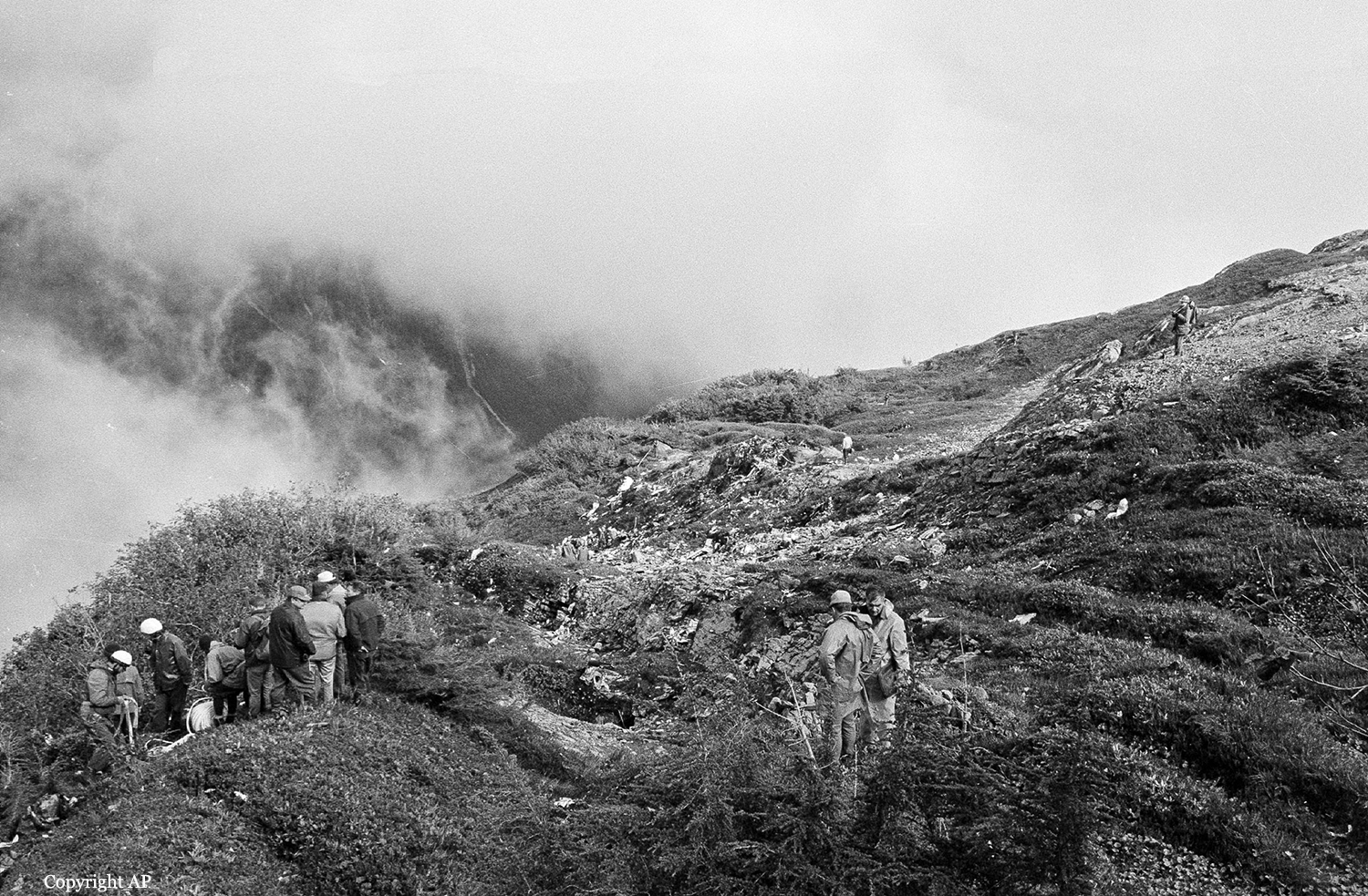
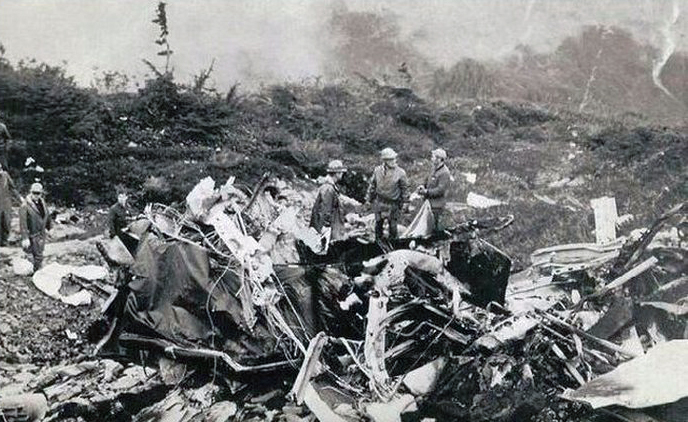
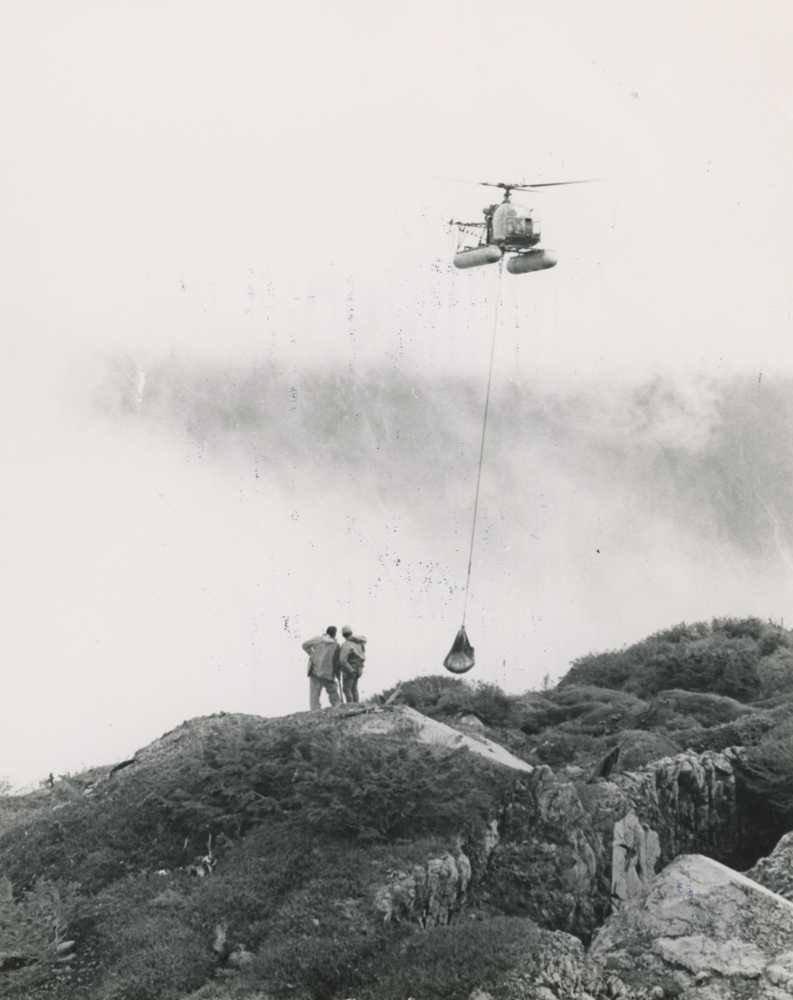
Alaska Airlines, Flight 1866 (AS66) was a scheduled passenger flight from Anchorage (ANC), to Seattle (SEA), with intermediate stops at Cordova (CDV), Yakutat (YAK), Juneau (JNU), and Sitka (SIT). The IFR flight departed Anchorage at 09:13 and landed at Cordova at 09:42. AS66 departed Cordova at 10:34 after a delay, part of which was attributable to difficulty in securing a cargo compartment door. The flight landed at Yakutat at 11:07. While on the ground, AS66 received an air traffic control clearance to the Juneau Airport via Jet Route 507 to the Pleasant Intersection, direct to Juneau, to maintain 9,000 feet or below until 15 miles southeast of Yakutat on course, then to climb to and maintain FL230. The flight departed Yakutat at 11:35, with 104 passengers and seven crew members on board. At 11:46, AS66 contacted the Anchorage ARTCC and reported level at FL230, 65 miles east of Yakutat. The flight was then cleared to descend at the pilot's discretion to maintain 10,000 ft so as to cross the Pleasant Intersection at 10,000 feet and was issued a clearance limit to the Howard Intersection. The clearance was acknowledged correctly by the captain and the controller provided the Juneau altimeter setting of 29.46 inches and requested AS66 to report leaving 11,000 ft. At 11:51, AS66 reported leaving FL230. Following this report, the flight's clearance limit was changed to the Pleasant Intersection. At 11:54, the controller instructed AS66 to maintain 12,000 feet. Approximately 1 minute later, the flight reported level at 12,000 feet. The changes to the flight's original clearance to the Howard Intersection were explained to AS66 by the controller as follows: "I've got an airplane that's not following his clearance, I've got to find out where he is." The controller was referring to N799Y, a Piper Apache which had departed Juneau at 11:44 on an IFR clearance, destination Whitehorse, Canada. On two separate occasions, AS66 acted as communications relay between the controller and N799Y. At 11:58, AS66 reported that they were at the Pleasant Intersection, entering the holding pattern, whereupon the controller recleared the flight to Howard Intersection via the Juneau localizer. In response to the controller's query as to whether the flight was "on top" at 12,000 feet, the captain stated that the flight was "on instruments." At 12:00, the controller repeated the flight's clearance to hold at Howard Intersection and issued an expected approach time of 12:10. At 12:01, AS66 reported that they were at Howard, holding 12,000 feet. Six minutes later, AS66 was queried with respect to the flight's direction of holding and its position in the holding pattern. When the controller was advised that the flight had just completed its inbound turn and was on the localizer, inbound to Howard, he cleared AS66 for a straight-in LDA approach, to cross Howard at or below 9,000 feet inbound. The captain acknowledged the clearance and reported leaving 12,000 feet. At 12:08 the captain reported "leaving five thousand five ... four thousand five hundred," whereupon the controller instructed AS66 to contact Juneau Tower. Contact with the tower was established shortly thereafter when the captain reported, "Alaska sixty-six Barlow inbound." (Barlow Intersection is located about 10 nautical miles west of the Juneau Airport). The Juneau Tower Controller responded, "Alaska 66, understand, ah, I didn't, ah, copy the intersection, landing runway 08, the wind 080° at 22 occasional gusts to 28, the altimeter now 29.47, time is 09 1/2, call us by Barlow". No further communication was heard from the flight. The Boeing 727 impacted the easterly slope of a canyon in the Chilkat Range of the Tongass National Forest at the 2475-foot level. The aircraft disintegrated on impact. The accident was no survivable.

Probable cause:
A display of misleading navigational information concerning the flight's progress along the localizer course which resulted in a premature descent below obstacle clearance altitude. The origin or nature of the misleading navigational information could not be determined. The Board further concludes that the crew did not use all available navigational aids to check the flight's progress along the localizer nor were these aids required to be used. The crew also did not perform the required audio identification of the pertinent navigational facilities.
Final Report:

Crash of a Stinson V-77 Reliant in Bettles: 1 killed

Date & Time: May 13, 1971 at 1015 LT
Type of aircraft:
Operator:
Registration:
N5709N
Survivors:
No
Schedule:
Fairbanks – Bettles
MSN:
77-33
Location:
Crew on board:
1
Crew fatalities:
Pax on board:
0
Pax fatalities:
Other fatalities:
Total fatalities:
1
Captain / Total flying hours:
1200
Captain / Total hours on type:
440.00
Circumstances:
While approaching Bettles Airport, the pilot initiated a steep left turn from low pass at strip located between close-in mountains when the aircraft lost height and crashed. The pilot, sole on board, was killed.
Probable cause:
Poor judgment on part of the pilot who failed to maintain flying speed. Observers reported wind strong, gusty.
Final Report:

Crash of a Douglas C-47B-15-DK in Red Devil

Date & Time: Mar 26, 1971 at 1845 LT
Registration:
N49319
Survivors:
Yes
Schedule:
Bethel – Red Devil
MSN:
15231/26676
YOM:
1944
Crew on board:
2
Crew fatalities:
Pax on board:
0
Pax fatalities:
Other fatalities:
Total fatalities:
0
Captain / Total flying hours:
7500
Captain / Total hours on type:
4000.00
Circumstances:
After touchdown at Red Devil Airfield, the airplane hit a 3-foot high unmarked snowberm and came to rest. Both crew members were uninjured while the aircraft was damaged beyond repair.
Probable cause:
The airport supervisory personnel failed to notify of unsafe conditions and failed to mark the obstruction. The following factors were reported:
- Unmarked obstructions at airport,
- Airport conditions, snow on runway,
- Overload failure,
- Unmarked snowberm on runway 3 feet high and 40 feet from the edge of the runway.
Final Report:

Crash of a Curtiss C-46D-10-CU Commando near Nondalton

Date & Time: Feb 10, 1971 at 1305 LT
Type of aircraft:
Operator:
Registration:
N10012
Flight Type:
Survivors:
Yes
Schedule:
Anchorage - Nondalton
MSN:
33271
YOM:
1945
Flight number:
RV012
Crew on board:
2
Crew fatalities:
Pax on board:
0
Pax fatalities:
Other fatalities:
Total fatalities:
0
Captain / Total flying hours:
13000
Captain / Total hours on type:
3280.00
Circumstances:
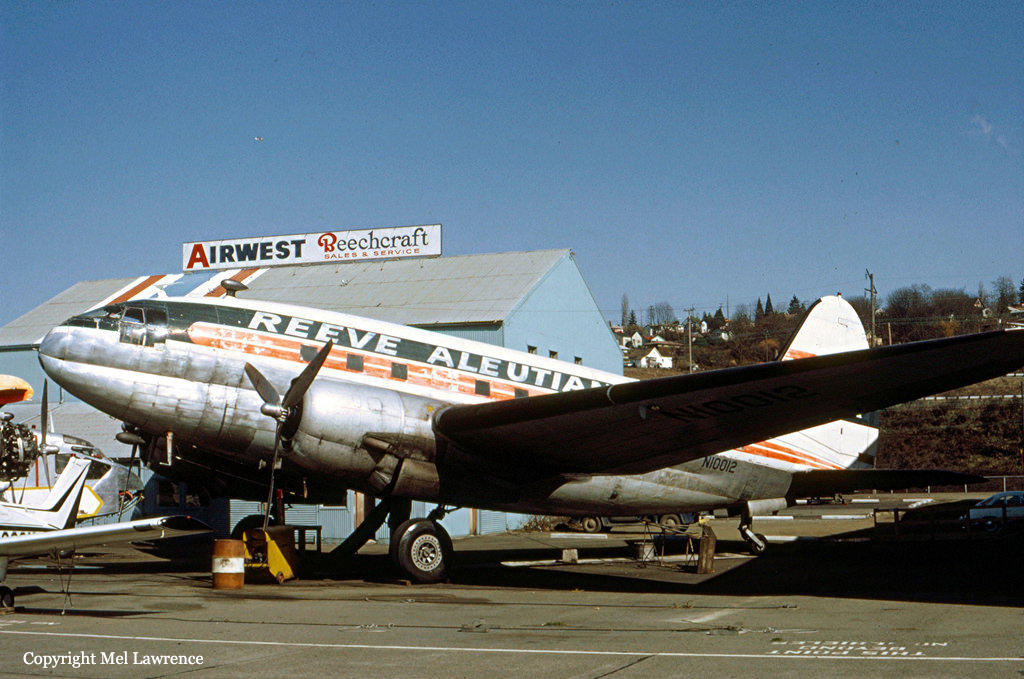
After landing on an icy lake located near Nondalton, the aircraft broke thru the ice and partially sank. Both pilots were injured and the aircraft was damaged beyond repair.
Probable cause:
Improper in-flight decisions or planning on part of the flying crew. The aircraft broke thru ice on lake. FSS had message for pilot on ice condition but the crew did not call the station before landing.
Final Report:

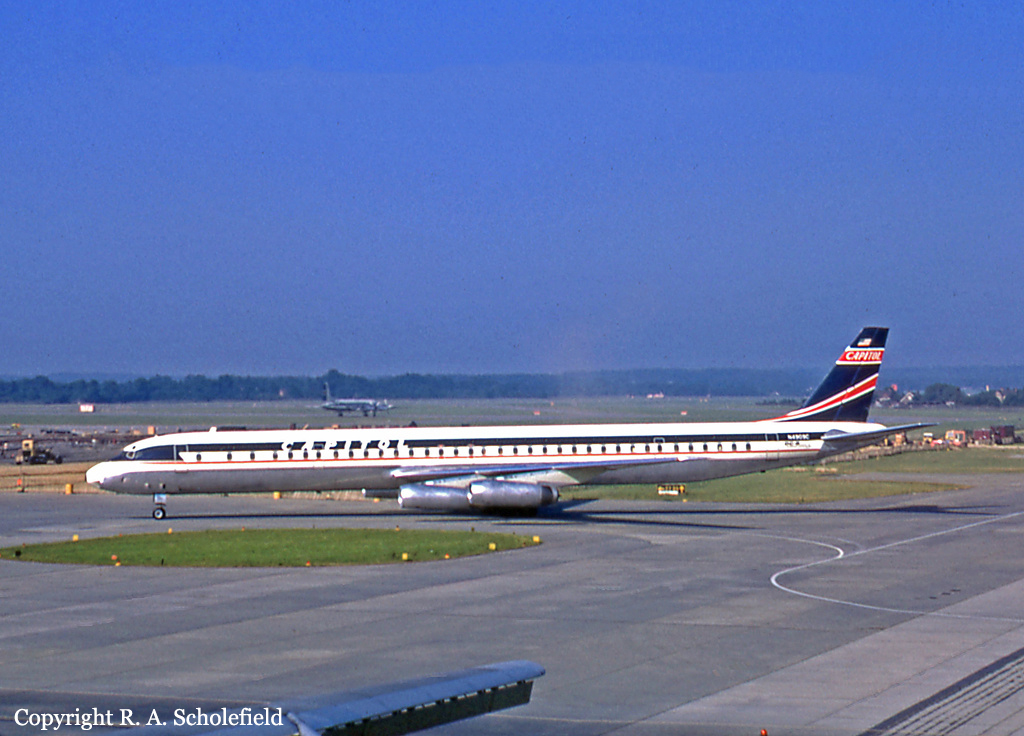
Crash of a Douglas DC-8-63CF in Anchorage: 47 killed

Date & Time: Nov 27, 1970 at 1705 LT
Type of aircraft:
Operator:
Registration:
N4909C
Flight Phase:
Survivors:
Yes
Schedule:
McChord – Anchorage – Yokota – Cam Ranh Bay
MSN:
46060/472
YOM:
1969
Flight number:
CL3/26
Crew on board:
10
Crew fatalities:
Pax on board:
219
Pax fatalities:
Other fatalities:
Total fatalities:
47
Captain / Total flying hours:
14650
Captain / Total hours on type:
5740.00
Copilot / Total flying hours:
13500
Copilot / Total hours on type:
2057
Aircraft flight hours:
4944
Circumstances:
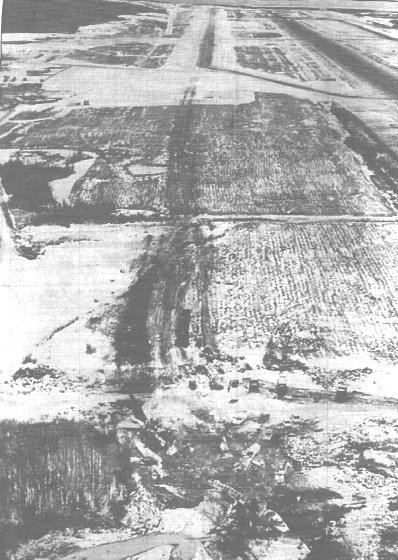
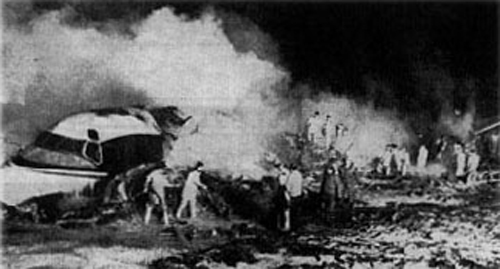
The airplane was completing a charter flight from McChord AFB to Cam Ranh Bay, Vietnam, with intermediate stops in Anchorage and Yokota, carrying 219 military personnels and 10 crew members. During the takeoff roll on runway 06R at Anchorage-Intl Airport, the airplane failed to gain sufficient speed and to get airborne. After V1 speed, the crew decided to abort the takeoff procedure but the airplane overran, struck a wooden barrier, an ILS structure, a 12-foot deep drainage ditch and came to rest in flames. A crew member and 46 passengers were killed while 182 other occupants were evacuated, 163 of them were wounded. The aircraft was destroyed by a post crash fire.
Probable cause:
The failure of the aircraft to attain the necessary airspeed to effect lift-off during the attempted takeoff. The lack of acceleration, undetected by the crew until after the aircraft reached V1 speed, was the result of a high frictional drag which was caused by a failure of all main landing gear wheels to rotate. Although it was determined that a braking pressure sufficient to lock all of the wheels was imparted to the brake system, the source of this pressure could not be determined. Possible sources of the unwanted braking pressure were either a hydraulic/brake system malfunction or an inadvertently engaged parking brake.
Final Report:

Crash of a Short SC.7 Skyvan 3 Variant 200 near Bettles

Date & Time: Oct 22, 1970 at 1450 LT
Type of aircraft:
Registration:
N123PA
Flight Phase:
Flight Type:
Survivors:
Yes
Schedule:
Prospect Creek - Dietrich Camp
MSN:
1861
YOM:
1969
Location:
Crew on board:
2
Crew fatalities:
Pax on board:
0
Pax fatalities:
Other fatalities:
Total fatalities:
0
Captain / Total flying hours:
9495
Captain / Total hours on type:
304.00
Circumstances:
While cruising at an altitude of 2,500 feet , the right engine failed. The crew feathered its propeller when the left engine lost power. The crew reduced his altitude and elected to make an emergency landing when the airplane struck trees and crashed near an icy river. Both pilots were uninjured while the aircraft was damaged beyond repair.
Probable cause:
Failure of the right engine in flight and partial loss of power on left engine caused by fuel contamination. The following factors were reported:
- Improperly serviced aircraft by owner-pilot,
- Fuel contamination-exclusive of water in fuel,
- Water in fuel,
- Failure of right engine in flight, propeller feathered,
- Left engine lost power,
- Sediment found in fuel storage tanks.
Final Report: