


Country
Operator Image

Crash of a Boeing 767 in Moroni: 125 killed
Date & Time:
Nov 23, 1996 at 1515 LT
Operator:
Registration:
ET-AIZ
Survivors:
Yes
Schedule:
Addis Ababa – Nairobi – Brazzaville – Lagos – Abidjan
MSN:
23916
YOM:
1987
Flight number:
ET961
Crew on board:
12
Crew fatalities:
Pax on board:
163
Pax fatalities:
Other fatalities:
Total fatalities:
125
Captain / Total hours on type:
4067.00
Copilot / Total hours on type:
3042
Aircraft flight hours:
32353
Aircraft flight cycles:
12623
Circumstances:
Ethiopian Airlines flight ET961 had taken off from Addis Ababa, Ethiopia, at 08:09 hours UTC for a scheduled flight to Abidjan, Ivory Coast via Nairobi, Kenya; Brazzaville, Congo; and Lagos, Nigeria. Twenty minutes after takeoff, at about 08:29 UTC, one passenger stood up from his seat and ran up the aisle to the cockpit, and two other passengers followed him heading for the cockpit. While rushing to the cockpit one of the men said "Everybody should be seated, I have a bomb!". Then they opened the cockpit door and stormed in. They declared to the pilots that there were eleven hijackers on board and beat the First Officer and forced him out of the cockpit. They then grabbed the fire axe and fire extinguisher bottle from their respective stowages and ordered the pilot-in-command to change direction and fly to Australia. The pilot-in-command explained to the hijackers that he had not enough fuel to reach Australia and demanded to make a refueling stop at Mombasa. The hijackers refused the refueling stop and continued arguing with the pilot-in-command. They insisted that they had learned from the inflight magazine that the B767 could fly 11 hours without refueling. After passing Dar es Salaam one of the hijackers ordered him to fly away from the coast, head to Australia and indicating to the altimeter not to descend below FL390. The pilot-in-command turned left towards the Comoros Island. The lead hijacker was sitting in the first officer's seat and was fiddling with the aircraft's controls, kicking the rudder, whilst also drinking whisky. The pilot-in-command kept on telling them that he was running short of fuel pointing to the fuel quantity indicators, but the hijackers did not listen. The leader continued fiddling with the controls, trying to turn the aileron and pulling the reverse thrust lever at random. As the flight came over the Comoros Islands the pilot-in-command saw the Moroni International Airport runway and circled 15-20 nm south of the field. Then the LOW FUEL CAUTION came on. The pilot-in-command pleaded to land because of low fuel. The hijackers were unconcerned and only insisted that the pilot not descend below FL390. At about 11:41 UTC the right engine ran down to wind milling speed. The pilot-in-command showed the red warning message for the right engine on the EICAS to the hijacker. At this moment, the hijacker left the right seat and went to the cabin door to discuss with the other two hijackers. This gave the captain the opportunity to pick up his microphone and address the passengers: "....ladies and gentlemen this is your pilot, we have run out of fuel and we are losing one engine this time, and we are expecting crash landing and that is all I have to say. we have lost already one engine, and I ask all passengers to react ..... to the hijackers ....". The hijacker then came back to the cockpit and hit the microphone out of the pilot's hand. After the right engine failed, the pilot started to descend the aircraft in order to increase speed, but the hijacker again interfered and violently played with the controls which resulted in improper control inputs. As a result the autopilot was disconnected and the flight became erratic with the airspeed varying between 216 and 336 kts. As the pilot regained control of the aircraft, the left engine went dead. The hijacker kept on instructing the pilot not to descend and again went to the cabin. Upon returning to the cockpit he saw that the altitude was decreasing, and angrily shouted at the pilot not to go any lower. The pilot said that the fuel was already finished and that the engines were without power. This time the hijacker instructed the captain not to touch the controls, and threatened to kill him. The captain said, "I am already dead because I am flying an airplane without engine power." The first officer, who had earlier been forced out to the First Class cabin, got up and, via the right aisle, went to the rear of the aircraft where he saw that a lot of economy class passengers had their life jackets on and that some had already inflated them. The first officer, along with the cabin crew members, helped the passengers to deflate the life jackets and showed them how the jackets should be re-inflated and how to assume the brace position during impact. While returning to the front of the aircraft, they repeated the same instructions as many times as they could. About less than 2 minutes before the ditching, the co-pilot forced his way to the cockpit shouting "let me help the pilot ...". After adjusting his seat and seat belts the pilot asked him for help since the controls were heavy. The hijackers still kept on struggling with the controls. By now, the aircraft was descending into the Indian Ocean over the Comoros Islands. The aircraft now had only standby instruments and RAT (Ram Air Turbine). The altimeter was indicating 150 feet and the airspeed was 200 kts. By this time the flight crew had been left alone to assume control. They turned the aircraft to the left in order to parallel the waves. However, the aircraft brushed the water in a left-wing-low attitude. It was then held straight and level after which it broke into four sections and came to rest in the sheltered waters 500 metres off Le Galawa Beach. Of the 175 occupants, 6 crew members and 119 passengers were fatally injured in the accident. Six crew members and 38 passengers sustained serious injuries, 2 passengers sustained minor injuries and 4 passengers received no injury.
Probable cause:
The Investigation Committee determines that the cause of this accident was unlawful interference by the hijackers which resulted in loss of engines thrust due to fuel exhaustion.
Final Report:


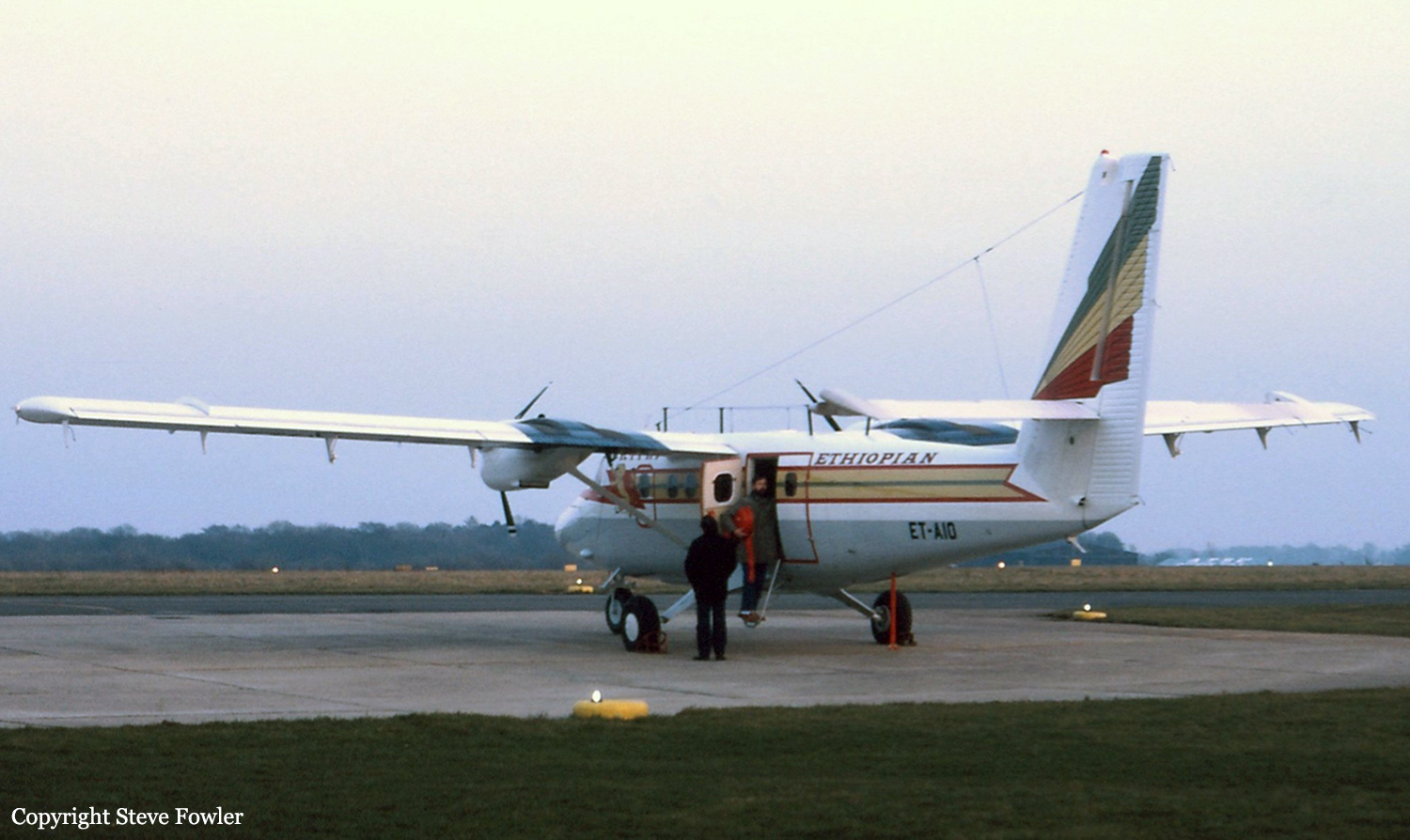
Crash of a De Havilland DHC-6 Twin Otter 300 in Addis Ababa
Date & Time:
Oct 22, 1995 at 0950 LT
Operator:
Registration:
ET-AIO
Survivors:
Yes
Schedule:
Kombolcha-Dessie – Addis Ababa
MSN:
818
YOM:
1985
Flight number:
ET173
Crew on board:
3
Crew fatalities:
Pax on board:
17
Pax fatalities:
Other fatalities:
Total fatalities:
0
Circumstances:
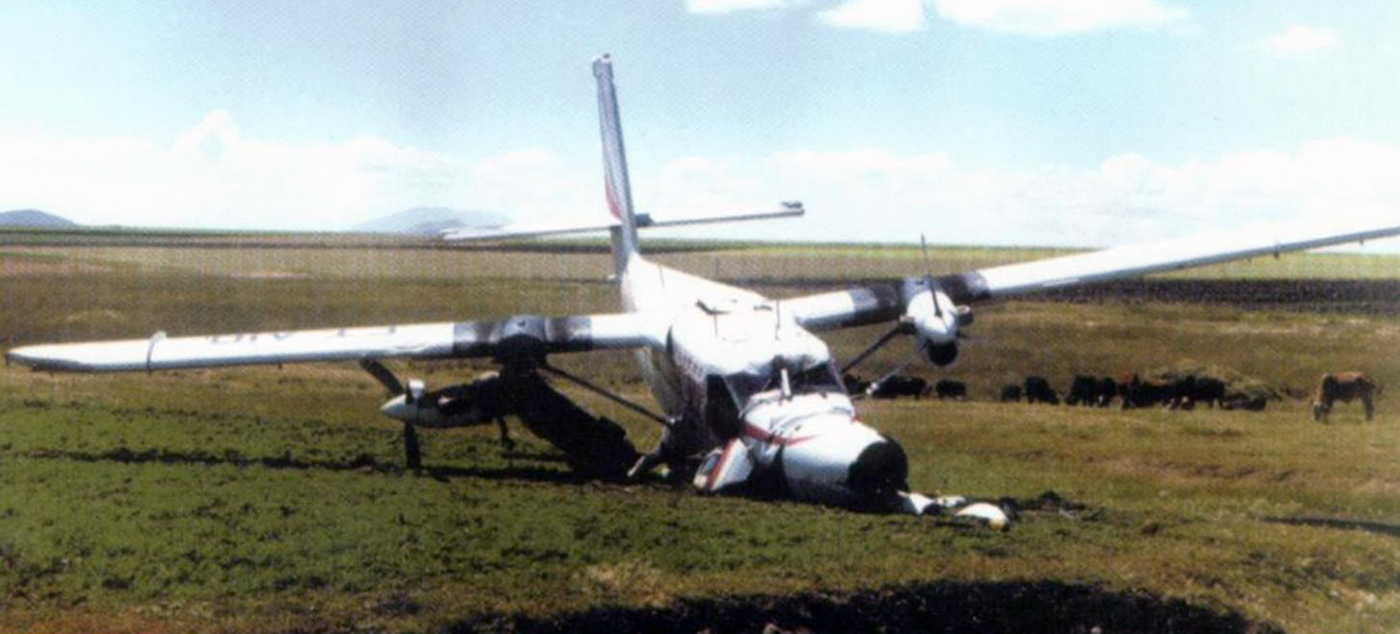
On final approach to Addis Ababa-Bole Airport, the twin engine aircraft collided with a white backed vulture of 5,4 kg. The windshield was broken and both pilots were seriously injured. Nevertheless, they elected to make an emergency landing when the aircraft crashed 300 metres short of runway. All 20 occupants were rescued, among them nine were injured.
Probable cause:
Loss of control on final approach following bird strike.
Crash of a Lockheed L-382G-67E Hercules near Djibouti City: 4 killed
Date & Time:
Sep 17, 1991
Operator:
Registration:
ET-AJL
Survivors:
No
Schedule:
Djibouti City - Addis Ababa
MSN:
5029
YOM:
1985
Crew on board:
4
Crew fatalities:
Pax on board:
0
Pax fatalities:
Other fatalities:
Total fatalities:
4
Circumstances:
The four engine aircraft was engaged in a special humanitarian flight from Djibouti City to Addis Ababa, carrying four crew members and a load of foodstuffs on behalf of the World Food Programme. After departure from Djibouti City, while climbing, the pilot informed ATC about technical problems with the main landing gear and was cleared to return. The crew initiated a turn when the aircraft struck the slope of Mt Arey located few km from Djibouti. The aircraft was destroyed upon impact and all four occupants were killed.
Probable cause:
It is believed that the crew focused on the main gear problems and failed to adhere to standard approach procedure, causing the aircraft to descend prematurely and to struck the mountain. Lack of crew coordination and lack of visibility were considered as contributing factors.
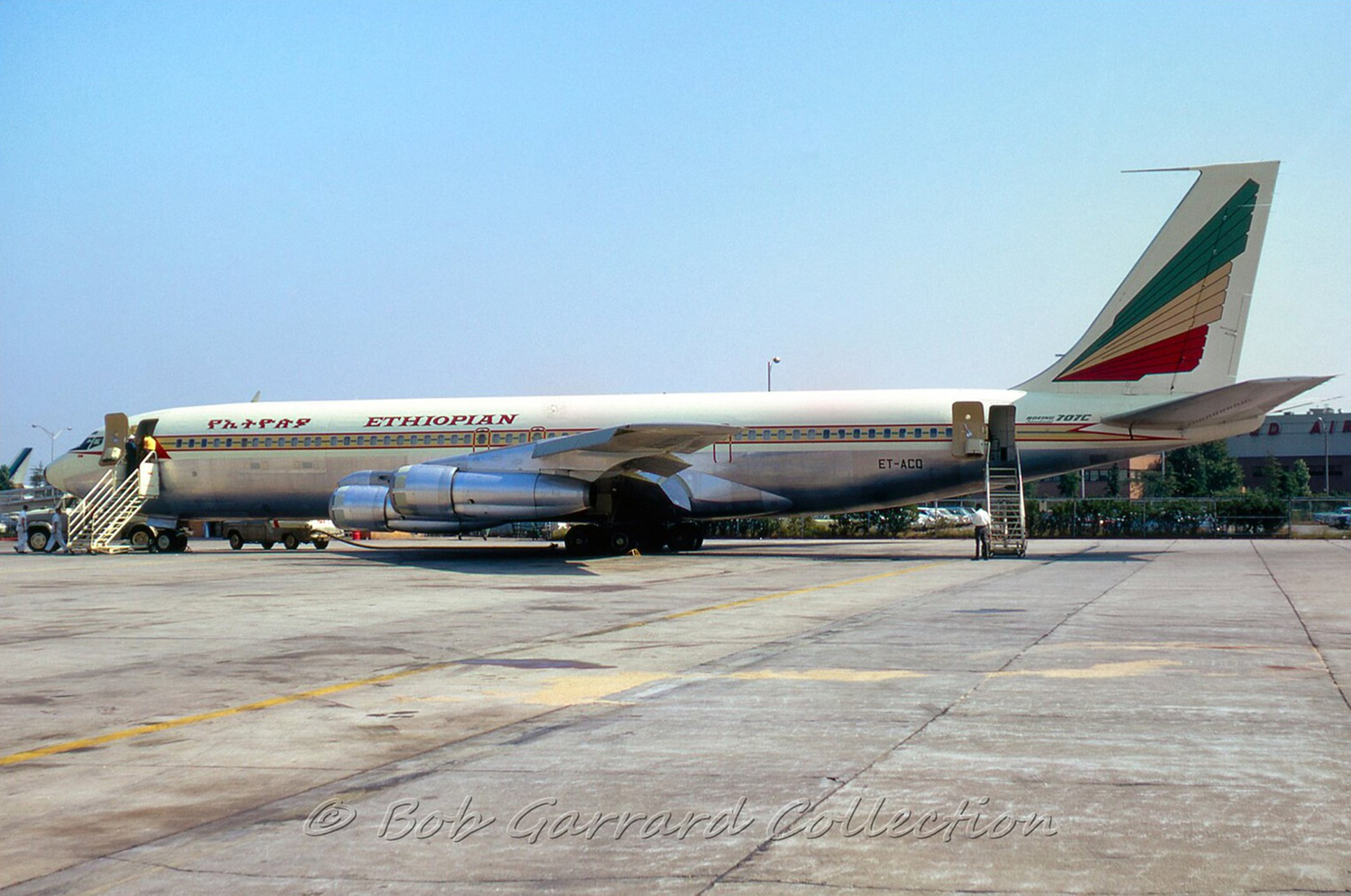
Crash of a Boeing 707-379C in Addis Ababa
Date & Time:
Jul 25, 1990 at 1116 LT
Operator:
Registration:
ET-ACQ
Survivors:
Yes
Schedule:
Addis Ababa - Asmara
MSN:
19820
YOM:
1968
Crew on board:
4
Crew fatalities:
Pax on board:
0
Pax fatalities:
Other fatalities:
Total fatalities:
0
Circumstances:
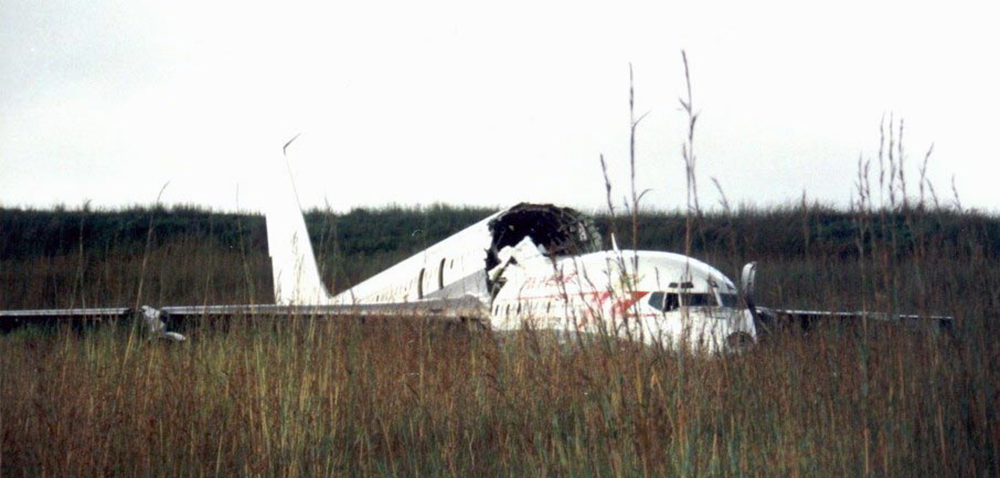
During the takeoff roll at Addis Ababa-Bole Airport runway 07, at a speed of about 100 knots, the captain spotted pigeons around the runway and shortly later, the power on engine n°2 and 3 dropped. The crew decided to abort the takeoff maneuver and initiated an emergency braking procedure. Unable to stop within the remaining distance, the aircraft overran, lost its undercarriage, went down an embankment and came to rest, broken in two. All four crew members escaped uninjured while the aircraft was written off.
Probable cause:
It was determined that both engine n°2 and 3 lost power after being hit by a flock of pigeons.
Crash of a De Havilland DHC-5D Buffalo in Gondar: 1 killed
Date & Time:
Nov 8, 1988 at 1045 LT
Operator:
Registration:
ET-AHI
Survivors:
Yes
Schedule:
Gondar - Addis Ababa
MSN:
101
YOM:
1981
Crew on board:
4
Crew fatalities:
Pax on board:
0
Pax fatalities:
Other fatalities:
Total fatalities:
1
Circumstances:
After takeoff from Gondar Airport, while on a cargo flight to Addis Ababa, the hydraulic pressure failed. As the crew was unable to raise the landing gear, the captain decided to return for an emergency landing. With flaps down at 7°, the aircraft landed 400 meters past the runway threshold. Following a course of 900 meters, the aircraft veered off runway and came to rest in a ditch. A crew member was killed while three others were injured.
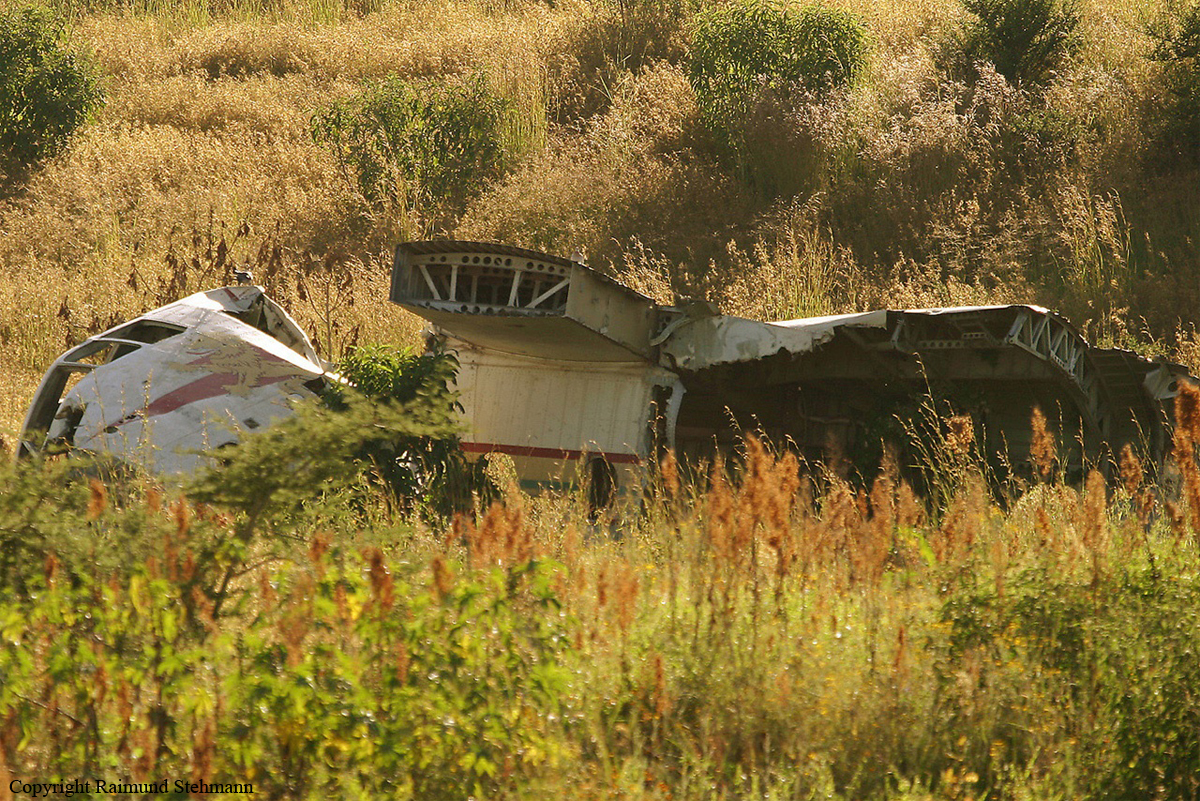
Crash of a Boeing 737-260 in Bahar Dar: 35 killed
Date & Time:
Sep 15, 1988 at 1305 LT
Operator:
Registration:
ET-AJA
Survivors:
Yes
Schedule:
Addis Ababa - Bahar Dar - Asmara
MSN:
23914
YOM:
1987
Flight number:
ET604
Crew on board:
6
Crew fatalities:
Pax on board:
98
Pax fatalities:
Other fatalities:
Total fatalities:
35
Captain / Total hours on type:
449.00
Aircraft flight hours:
1377
Aircraft flight cycles:
1870
Circumstances:
Ethiopian Airlines flight 604, a Boeing 737-200, was a scheduled service from Addis Ababa to Bahar Dar and Asmara. The first leg of the flight was uneventful. At 09:50, the engines were started normally and the airplane was taxied to its take-off position. The flight crew reported that In order to gain additional thrust they elected not to use engine bleed air during take-off. The airplane accelerated at a normal rate during the take-off roll and passed V1 (take-off-reject) speed. As the airplane passed V1 and very near VR (rotation speed) the flight crew saw a flock of pigeons lifting up from the left side. At this time the captain took over control from the copilot and pulled up. Almost immediately after rotation, the airplane struck the flock of pigeons at an airspeed of 146 knots and altitude of 5730 feet above mean sea level. Loud bangs were heard. The captain then called for gear up and the copilot complied. At approximately 100-200 ft. above the ground, both engines started backfiring. At this time, the flight crew reported that they experienced a considerable power loss and the airplane started mushing down at which time the captain "fire walled" the thrust levers. The engines reportedly responded and the airplane began to gain some altitude. The gain in attitude encouraged the captain to make a right turn away from Lake Tana and back to the take-off runway for landing. During the initial 32 seconds after the impact, the airplane had gained altitude from 5,730 feet to 6,020 feet and had accelerated from 146 knots to 154 knots. The crew report further indicated that both engines continued to surge and the exhaust gas temperature gauges (EGT) were reading at the top extreme and the engine pressure ratio (EPR) gauge readings were fluctuating at about 1.6. During this time the captain reported that the he reduced engine thrust to prolong the operational life of the engines. The frequency of the surges decreased with engines power reduction. The airplane entered an approximate 90 degree right turn. Altitude remained constant 6,020 feet while its airspeed increased from 154 knots to 162 knots. The airplane then began another right turn and entered the downwind leg of the return to runway 04. Altitude had increased to 6,410 feet and airspeed to 173 knots. On the downwind leg the aircraft further climbed to 7,100 feet. Then, within a timeframe of about five seconds, both engines lost power completely. The copilot pointed out a cleared area slightly ahead and to the right. The captain then turned towards the clearing and performed a gear-up landing. The aircraft broke up and a fire erupted. Out of the 104 occupants, 35 suffered fatal injuries.
Probable cause:
The accident occurred because the airplane could not be safely returned to the runway after the internal destruction and subsequent failure of both engines to operate arising from multiple bird ingestion by both engines during take-off.


Crash of a Douglas C-47B-15-DK in Robe
Date & Time:
Dec 28, 1987
Operator:
Registration:
ET-AGO
Survivors:
Yes
MSN:
15287/26732
YOM:
1944
Crew on board:
4
Crew fatalities:
Pax on board:
3
Pax fatalities:
Other fatalities:
Total fatalities:
0
Circumstances:
Shortly after takeoff from Robe Airport, while climbing, the left engine lost power (down to 1,500 rpm) and the crew encountered severe vibrations. The captain decided to return to land to runway 15 but as he realized he could not make it, he attempted an emergency landing. The aircraft completed a belly landing in an open field located 2 km north of the airport. All seven occupants evacuated safely while the aircraft was damaged beyond repair.
Crash of a De Havilland DHC-6 Twin Otter 300 in Dembi Dolo
Date & Time:
Jun 22, 1986 at 0408 LT
Operator:
Registration:
ET-AIQ
Survivors:
Yes
Schedule:
Addis Ababa - Dembidolo
MSN:
819
YOM:
1985
Crew on board:
3
Crew fatalities:
Pax on board:
17
Pax fatalities:
Other fatalities:
Total fatalities:
0
Circumstances:
On approach to Dembidolo by night and stratus clouds, the crew failed to realize his altitude was too low. While facing a mountain, the crew increased engine power to gain height but the aircraft stalled, lost altitude and crashed on a hilly terrain located few km from the airfield. All 20 occupants were injured while the aircraft was damaged beyond repair.
Crash of a Douglas C-47A-1-DK in Mekele
Date & Time:
Aug 24, 1982
Operator:
Registration:
ET-AHP
Survivors:
Yes
MSN:
12381
YOM:
1944
Crew on board:
0
Crew fatalities:
Pax on board:
0
Pax fatalities:
Other fatalities:
Total fatalities:
0
Aircraft flight hours:
24088
Circumstances:
During the takeoff roll at Mekele-Alula Aba Nega Airport, a tire burst. The aircraft went out of control, veered off runway and came to rest. There were no casualties.
Probable cause:
Loss of control during takeoff after a tire burst.