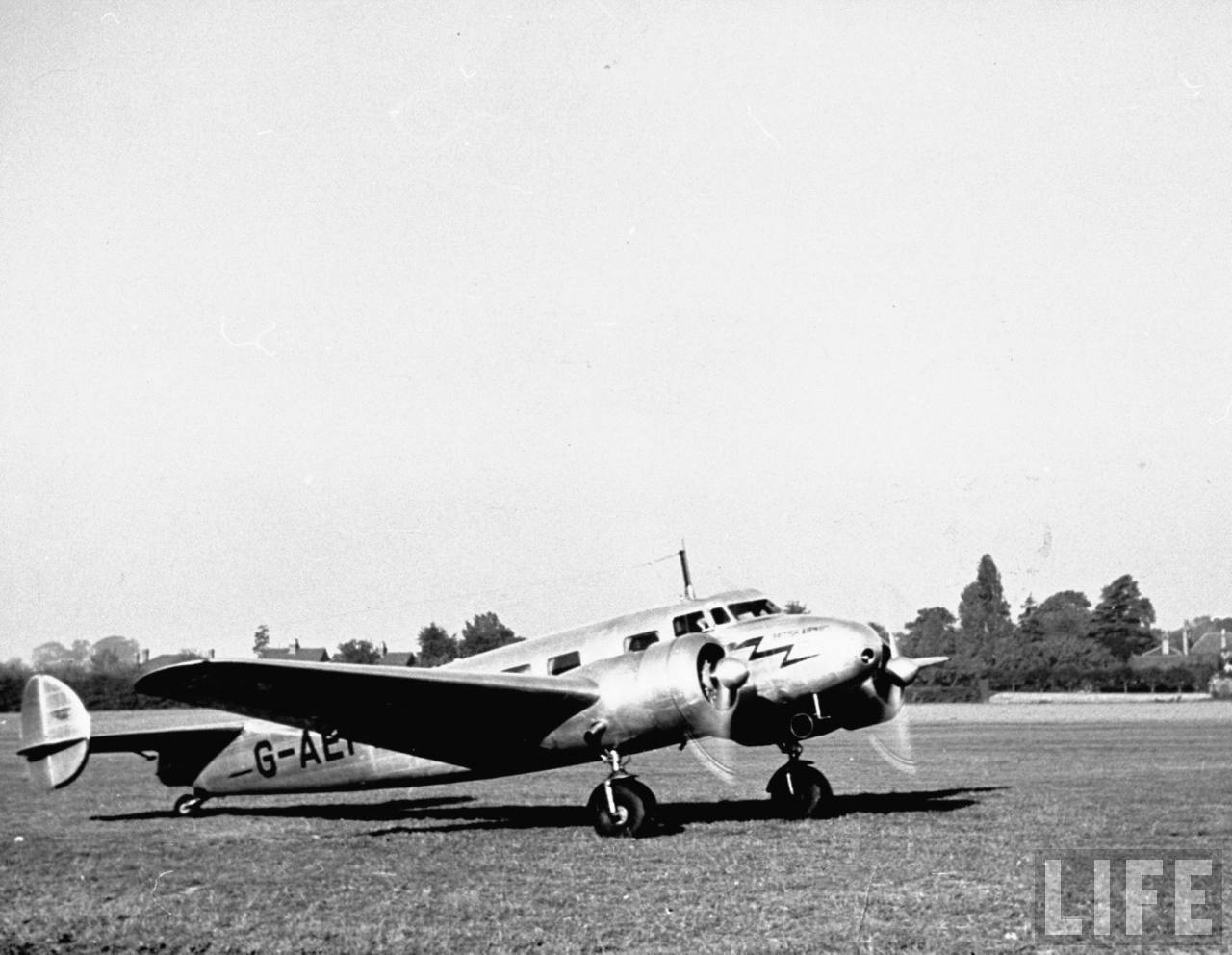
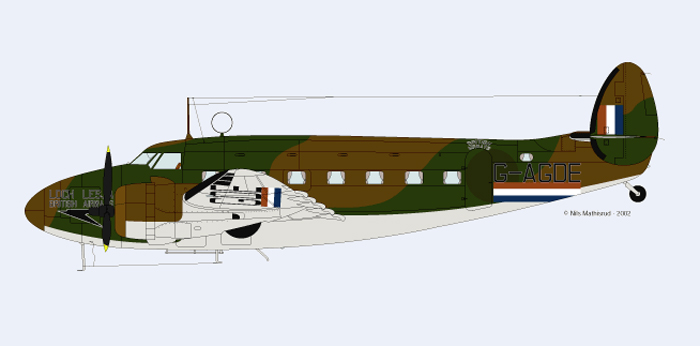
Crash of a Lockheed 18-56 LodeStar off RAF Leuchars: 10 killed

Date & Time: Dec 17, 1943 at 2245 LT
Type of aircraft:
Operator:
Registration:
G-AGDE
Survivors:
No
Schedule:
Stockholm - Leuchars
MSN:
2086
YOM:
1941
Region:
Crew on board:
3
Crew fatalities:
Pax on board:
7
Pax fatalities:
Other fatalities:
Total fatalities:
10
Circumstances:
Following an uneventful flight from Stockholm-Bromma Airport, the twin engine aircraft was descending to RAF Leuchars in marginal weather and icing conditions. By night, while cruising at a height of 6,000 feet, the aircraft went out of control and dove into the sea some 24 km off the Airbase. SAR operations were quickly deployed on site but no trace of the aircraft nor the 10 occupants was found.
Probable cause:
Control was lost on approach to RAF Leuchars due to excessive ice accumulation on wings surface and fuselage while the aircraft was flying in icing conditions.

Crash of a Lockheed 10A Electra in Cairo

Date & Time: Nov 19, 1943
Type of aircraft:
Operator:
Registration:
G-AFCS
Survivors:
Yes
MSN:
1025
YOM:
1938
Country:
Region:
Crew on board:
0
Crew fatalities:
Pax on board:
0
Pax fatalities:
Other fatalities:
Total fatalities:
0
Circumstances:
Crashed in unknown circumstances at Cairo-Almaza Airport. There were no casualties but the aircraft christened 'Lea' was written off.

Crash of a Short S.25 Sunderland III in Libya: 19 killed

Date & Time: Nov 5, 1943 at 2245 LT
Type of aircraft:
Operator:
Registration:
G-AGIB
Flight Phase:
Survivors:
No
Site:
Schedule:
Cairo - Djerba - Poole
YOM:
1943
Country:
Region:
Crew on board:
9
Crew fatalities:
Pax on board:
10
Pax fatalities:
Other fatalities:
Total fatalities:
19
Circumstances:
While cruising over Libya by night and in good weather conditions, one the right engine caught fire. The crew reduced his altitude in an attempt to make an emergency landing in the desert but while descending, the aircraft went out of control and crashed in flames some 150 km southeast of Tobruk. All 19 occupants were killed.
Probable cause:
According to officials, a fire with very high intensity broke out on one of both right engines and quickly spread to the right wing that separated during the descent, causing the plane to crash.

Crash of a Short S.25 Sunderland III near Brandon: 10 killed

Date & Time: Jul 28, 1943 at 0520 LT
Type of aircraft:
Operator:
Registration:
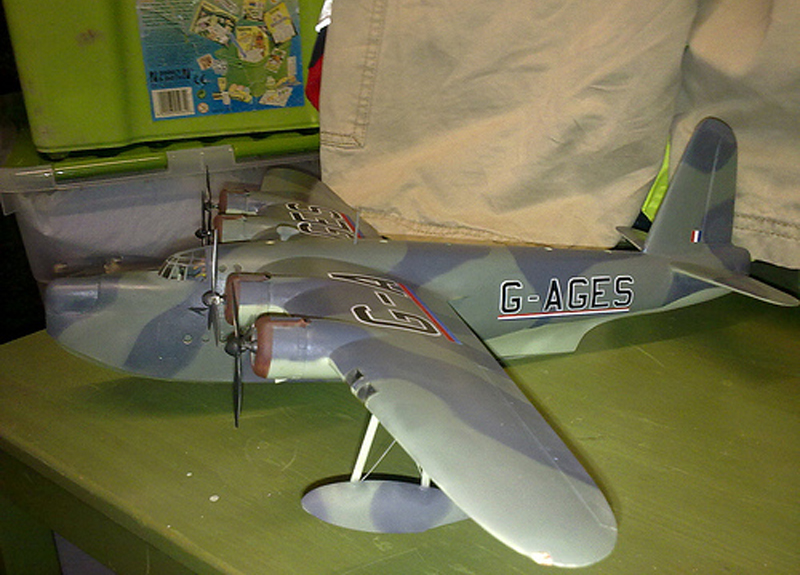
G-AGES
Survivors:
Yes
Site:
Schedule:
Lagos – Lisbon – Foynes
YOM:
1942
Country:
Region:
Crew on board:
7
Crew fatalities:
Pax on board:
18
Pax fatalities:
Other fatalities:
Total fatalities:
10
Circumstances:
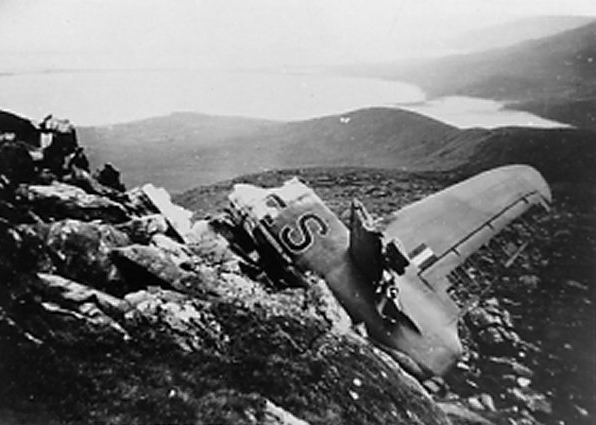
By night, the crew overflew the Shannon estuary and continued to the north at an altitude of 6,000 feet. Forty-five minutes later, the captain disengaged the automatic pilot system and started the descent manually. After passing through the last cloud layer, the crew distinguished the ground but did not realized that his altitude was to low. The seaplane hit the slope of Mt Brandon with its right wing, stalled and crashed in flames southwest of Brandon village. Fifteen occupants were injured while ten others were killed, among them the captain.
Crew:
Thomas Allitt, pilot, †
John Harrop Slater, copilot,
Eric William Vincent, navigator,
Charles Harry P. Phillips, radio operator,
Frederick Thomas James Parr, radio operator,
Victor Rawlinson, flight engineer,
Ralph Bousquet Lawes, flight engineer.
Passengers:
David William Stannard, †
John Diarmuid Hartigan, †
Arthur Friedrich Rawson Lumby, †
William Sacheverell Hebden,
Lewis Milner, †
Sidney Leonard Pullinger, †
Ian Kenneth Thom, †
Harold Tristram, †
Thomas Watson Thomson,
Kenneth Joseph Devall, †
Leonard King,
Victor Francis Edward Simmons,
Oliver Frith,
Alfred Brooker Depree,
Max Albert Roth, †
Lloyd Gilbert French,
Roy Elliott Bertram,
Raymond François Larche.
Source: http://www.csn.ul.ie/~dan/war/gages.pdf
Probable cause:
Navigation for the flight west from Foynes was by compass and loop bearing on the ground radio station and there was no request from the aircraft for QTE bearings to be transmitted from the radio station. If it is assumed that the aircraft's loop bearing on the radio station was free from error, the alteration in the aircraft's track should have been immediately apparent by a change in the compass course. Alternatively, if the course remained constant the alteration in track should have been indicated by a change in the loop bearing. The departure from the required track was not discovered by the crew and the reason for this is not conclusively evident. Radio direction-finding apparatus of the type used on the aircraft is subject to error around sunset and sunrise. The presence of this error, known as “Night Effect” cannot always be detected, even by experienced radio operators. The probable final cause of the accident was “Night Effect” which affected the accuracy of the direction-finding apparatus on the aircraft. The contributory causes of the accident may be summarized as follows:
- A strong south-westerly wind which resulted in the aircraft's arriving at Shannon Airport thirty minutes before its scheduled time of arrival;
- A change in wind direction from S.W. To N.W. in the Shannon area around the actual time of arrival;
- The pilots error in technique in relying entirely on the aircraft's loop bearings for radio assistance to the exclusion of direction signals from the ground station.


Crash of a De Havilland DH.91 Albatross in Shannon

Date & Time: Jul 6, 1943
Operator:
Registration:
G-AFDK
Survivors:
Yes
Schedule:
Bristol – Shannon
MSN:
6804
YOM:
1938
Location:
Country:
Region:
Crew on board:
5
Crew fatalities:
Pax on board:
9
Pax fatalities:
Other fatalities:
Total fatalities:
0
Circumstances:
On touchdown at Shannon-Rinneanna Airport, the aircraft went out of control, veered off runway and came to rest. While all 14 occupants escaped uninjured, the aircraft was damaged beyond repair.
Crew:
Geoffrey Palliser Moss, pilot,
D. M. Revell, radio operator,
C. Caseley, flight engineer,
R. Gilmour,
A. H. Wigmore.
Passengers:
Neil Richardson,
Simon Marks,
Pauline Gower,
Gerard d'Erlanger,
John Marchbank,
David Smillie Smith MacDowall,
Grahame Temple Meller,
Keith Granville,
Piers John Barnes Wimbush.

Crash of a Lockheed L-414 Hudson VI in Khartoum: 16 killed

Date & Time: Jun 30, 1943
Type of aircraft:
Operator:
Registration:
FK618
Flight Phase:
Flight Type:
Survivors:
No
Schedule:
Khartoum – Takoradi
MSN:
414-7094
YOM:
1943
Country:
Region:
Crew on board:
3
Crew fatalities:
Pax on board:
13
Pax fatalities:
Other fatalities:
Total fatalities:
16
Circumstances:
Shortly after take off, while climbing, the aircraft stalled and crashed in a desert area near the airport. All 16 occupants were killed. It is possible that the aircraft was overloaded at the time of the accident.
Crew:
Sgt C. M. Adams, pilot,
Sgt G. S. Antrobus, pilot,
Cpt M. F. Attwell.
Passengers:
Sgt A. L. Carruthers,
F/O J. I. Douglas,
Sgt J. S. Eason,
F/Sgt Walerian Mislag,
F/O C. S. Nicholls,
F/Sgt C. G. Pay,
W/O C. G. Pinkney,
F/Sgt H. Ross,
W/O J. E. Sendall,
Sgt V. Wade,
F/Lt J. J. Wojciechowski,
F/Sgt A. Wright,
F/Sgt G. J. Yule.

Crash of a Lockheed L-414 Hudson VI in Khartoum: 17 killed

Date & Time: Jun 16, 1943 at 0835 LT
Type of aircraft:
Operator:
Registration:
FK459
Flight Type:
Survivors:
No
Schedule:
Takoradi – Khartoum
MSN:
414-6935
YOM:
1943
Country:
Region:
Crew on board:
3
Crew fatalities:
Pax on board:
14
Pax fatalities:
Other fatalities:
Total fatalities:
17
Circumstances:
The twin engine aircraft was performing a flight to Khartoum on behalf of the Royal Air Force. On final approach, at a height of 800 feet, pilots completed a last turn to the left to join the glide slope when the aircraft banked left, stalled and crashed in a huge explosion. A passenger was seriously injured while all 16 other occupants were killed. A day later, the only survivor died from his injuries.
Crew:
P/O George Edward Harris, pilot,
Sgt James Lissett, copilot,
Sgt Brian James Cox, wireless operator and air gunner.
Passengers:
Sgt Douglas Elliott Guy Brown,
F/Sgt John Creighton,
W/O Neil Francis Gray,
F/Sgt Grochowski,
Sgt James Sidney Harris,
F/Sgt Albert Partington,
F/Sgt Samuel Leonard Pointon,
W/O Charles Matthew Raven,
S/L George Michael Roddy,
Sgt Ronald William Smith,
F/Sgt Stankowiak,
Francis Charles Tanner,
F/Sgt Tetnowsky,
W/O Tonczak.
Probable cause:
Fuel starvation, probably caused by a partial air lock due to surging of petrol in near empty tanks, was thought to have caused the port engine to cut during the last turn to the left.

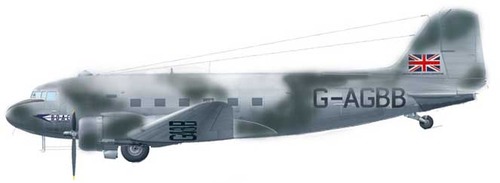
Crash of a Douglas DC-3-194 into the Bay of Biscay: 17 killed

Date & Time: Jun 1, 1943 at 1254 LT
Type of aircraft:
Operator:
Registration:
G-AGBB
Flight Phase:
Survivors:
No
Schedule:
Lisbon – Bristol
MSN:
1590
YOM:
1936
Flight number:
2L777
Country:
Region:
Crew on board:
4
Crew fatalities:
Pax on board:
13
Pax fatalities:
Other fatalities:
Total fatalities:
17
Circumstances:
The aircraft left Lisbon-Portela de Sacavém at 0730LT on a regular schedule flight to Bristol-Whitchurch Airport. While cruising over the Bay of Biscay, the aircraft was intercepted and shot down by eight German Junkers JU.88 fighters. The civil aircraft went out of control and crashed into the sea some 350 km north of La Coruna. All 17 occupants, among them the British actor Leslie Howard, were killed.
Crew:
Cpt Quirinus Tepas Obe, pilot,
Cpt Dirk de Koning, pilot,
Cornelis van Brugge, radio operator,
Engbertus Rosevink, flight engineer.
Passengers:
Leslie Howard,
Alfred T. Chenhalls,
Kenneth Stonehouse,
Evelyn Peggy Margetts Stonehouse,
Rotha Hutcheon
Petra Hutcheon,
Carolina Hutcheon,
Cecelia Emilia Falla Paton,
Tyrrell Mildmay Shervington,
Ivan James Sharp,
Wilfrid Israel,
Francis German Cowlrick,
Gordon Thompson MacLean.
Probable cause:
Shot down by German fighters. Theories abound that the aircraft, a Douglas DC-3, was attacked because the Germans believed that British Prime Minister Winston Churchill was aboard. Other theories suggest the DC-3 was targeted because several passengers, including Howard, were British spies. During the Second World War, British and German civilian aircraft operated out of the same facilities at Portela and the incoming and outgoing traffic was watched by Allied and Axis spies. The Lisbon - Bristol route frequently carried agents and escaped PoWs to Britain.

Crash of a Lockheed 18-40 LodeStar off Skagen: 7 killed

Date & Time: Apr 4, 1943 at 0138 LT
Type of aircraft:
Operator:
Registration:
G-AGEJ
Flight Phase:
Survivors:
No
Schedule:
Stockholm – Leuchars
MSN:
2085
YOM:
1942
Country:
Region:
Crew on board:
4
Crew fatalities:
Pax on board:
3
Pax fatalities:
Other fatalities:
Total fatalities:
7
Circumstances:
En route from Stockholm-Bromma Airport to RAF Leuchars, while cruising at night off the Danish coast, the twin engine airplane was shot down by a German fighter and crashed into the sea about 50 km northwest of Skagen. All seven occupants were killed.
Crew:
Cpt Erik Engnæs, pilot
F/O Per Aas, pilot,
Lt Oddvar Wenger,
Harald Pillgram Wilhelmsen, radio operator.
Probable cause:
Shot down by a German fighter.