


Country
Operator Image

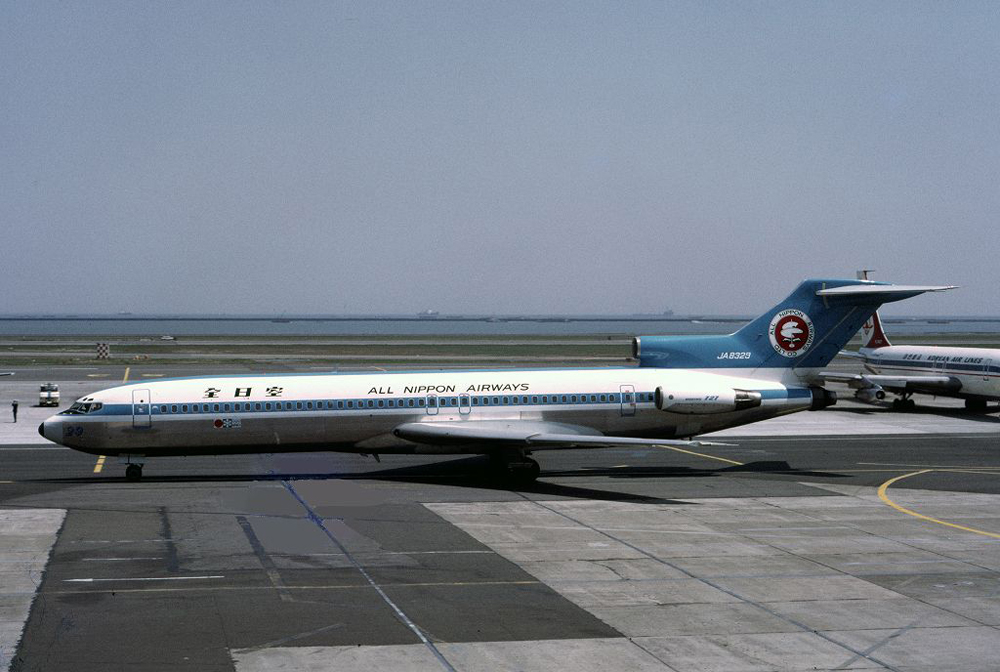
Crash of a Boeing 727-281 near SHizukuishi: 162 killed
Date & Time:
Jul 30, 1971 at 1402 LT
Operator:
Registration:
JA8329
Survivors:
No
Schedule:
Sapporo - Tokyo
MSN:
20436/788
YOM:
1971
Flight number:
NH058
Crew on board:
7
Crew fatalities:
Pax on board:
155
Pax fatalities:
Other fatalities:
Total fatalities:
162
Aircraft flight hours:
865
Circumstances:
The Boeing 727 departed Sapporo-Chitose Airport on a regular schedule flight to Tokyo-Haneda, carrying a crew of 7 and 155 passengers. While cruising at 28,000 feet, the airplane collided with a Japan Air-Self Defence Force North American F-86F Sabre registered 92-7932 and carrying a crew of two. Following the collision, both aircraft went out of control, dove into the ground and crashed in a mountainous area located south of Shizukuishi. While both military pilots were able to eject and were uninjured, all 162 occupants on board the 727 were killed.
Probable cause:
It was determined that the military pilot under training failed to see and avoid other traffic while conducting a training mission. Relatively inexperienced, the trainee pilot had a total of 25 flying hours and delayed a corrective manoeuvre as ordered by his instructor. This caused the right wing of the Sabre to struck the horizontal stabilizer of the B727.
The following factors were identified:
- The instructor continued the training flight without noticing that he had left the training airspace and entered the jet route J11L.
- It is estimated that the All Nippon Airways pilots saw the training aircraft at least 7 seconds before the collision, but the avoidance operation was not performed until just before the collision. This is probably because the ANA pilot did not anticipate the collision.
- For the instructor, the trainee's instruction to avoid a collision was shortly given to the trainee immediately before he saw the ANA aircraft, and he could not avoid the trainee's collision. This is probably because the instructor was unable to see the ANA aircraft.
- About two seconds before the collision, the trainee visually recognized the ANA aircraft slightly to the right of the accident aircraft, and immediately performed an avoidance operation, but was unable to avoid the collision. It is considered that this is because the trainee had little experience in this manoeuvre and was mainly devoted to maintaining the relative position with the instructor aircraft, and it was delayed in observing the ANA aircraft.
The following factors were identified:
- The instructor continued the training flight without noticing that he had left the training airspace and entered the jet route J11L.
- It is estimated that the All Nippon Airways pilots saw the training aircraft at least 7 seconds before the collision, but the avoidance operation was not performed until just before the collision. This is probably because the ANA pilot did not anticipate the collision.
- For the instructor, the trainee's instruction to avoid a collision was shortly given to the trainee immediately before he saw the ANA aircraft, and he could not avoid the trainee's collision. This is probably because the instructor was unable to see the ANA aircraft.
- About two seconds before the collision, the trainee visually recognized the ANA aircraft slightly to the right of the accident aircraft, and immediately performed an avoidance operation, but was unable to avoid the collision. It is considered that this is because the trainee had little experience in this manoeuvre and was mainly devoted to maintaining the relative position with the instructor aircraft, and it was delayed in observing the ANA aircraft.
Final Report:
Crash of a Beechcraft H18 at Ōmura AFB
Date & Time:
Feb 14, 1971
Operator:
Registration:
JA5169
Survivors:
Yes
Schedule:
Ōmura - Ōmura
MSN:
BA-761
YOM:
1969
Crew on board:
0
Crew fatalities:
Pax on board:
0
Pax fatalities:
Other fatalities:
Total fatalities:
0
Circumstances:
Crashed in unknown circumstances at Ōmura AFB while completing a training flight. There were no casualties.
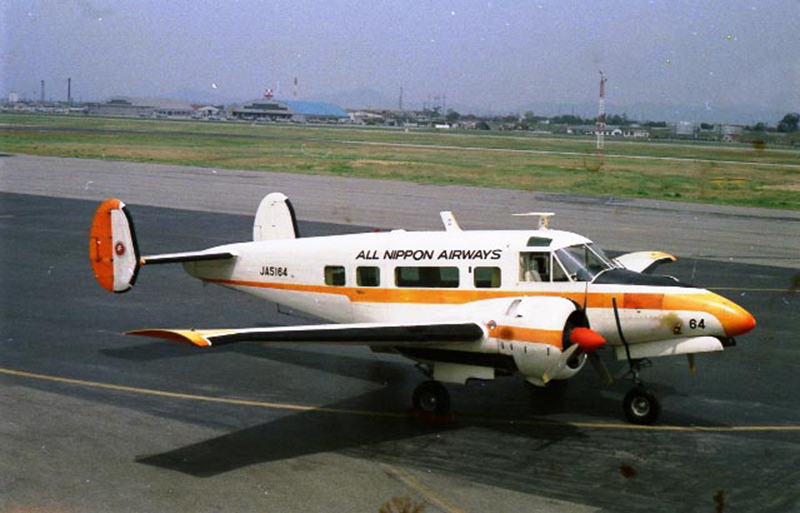
Crash of a Beechcraft H18 in Nagoya
Date & Time:
Feb 14, 1971
Operator:
Registration:
JA5164
Survivors:
Yes
Schedule:
Nagoya - Nagoya
MSN:
BA-756
YOM:
1969
Crew on board:
0
Crew fatalities:
Pax on board:
0
Pax fatalities:
Other fatalities:
Total fatalities:
0
Circumstances:
Crashed in unknown circumstances at Nagoya Airport while completing a training flight. There were no casualties.
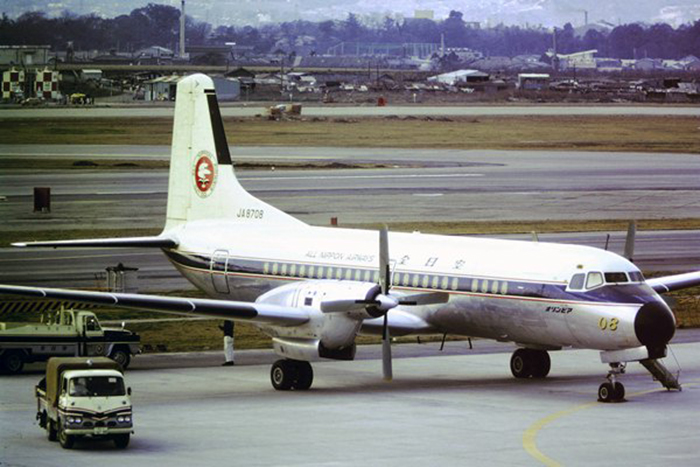
Crash of a NAMC YS-11A-213 in Miyazaki
Date & Time:
Oct 20, 1969
Operator:
Registration:
JA8708
Survivors:
Yes
Schedule:
Kagoshima - Miyazaki
MSN:
2085
YOM:
1968
Flight number:
NH104
Crew on board:
4
Crew fatalities:
Pax on board:
49
Pax fatalities:
Other fatalities:
Total fatalities:
0
Circumstances:
The airplane landed too far down on a wet runway and was unable to stop within the remaining distance. It overran and lost its undercarriage before coming to rest 132 meters further. All 53 occupants escaped uninjured while the aircraft was written off.
Probable cause:
Wrong approach configuration on part of the flying crew who landed too far down the runway, reducing the landing distance available. At the time of the accident, the runway was wet and the aircraft also suffered aquaplaning.
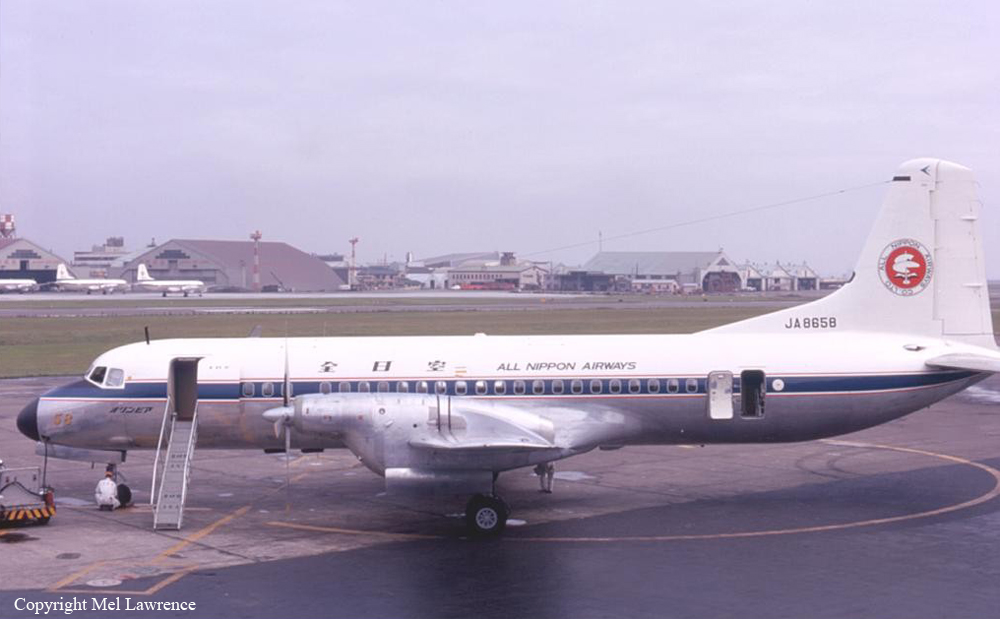
Crash of a NAMC YS-11-111 off Matsuyama: 50 killed
Date & Time:
Nov 13, 1966 at 2028 LT
Operator:
Registration:
JA8658
Survivors:
No
Schedule:
Osaka - Matsuyama
MSN:
2023
YOM:
1966
Flight number:
NH533
Crew on board:
5
Crew fatalities:
Pax on board:
45
Pax fatalities:
Other fatalities:
Total fatalities:
50
Captain / Total hours on type:
484.00
Copilot / Total hours on type:
739
Aircraft flight hours:
1070
Circumstances:
Flight 533 was a scheduled domestic.flight from Osaka International Airport to Matsuyama Airport. It departed Osaka International Airport at 1913 hours, one hour and twenty-five minutes behind schedule with an ATC clearance via G-4, Kure Point, direct Matsuyama NDB at an altitude of 8 000 ft. At 1940 hours it flew over Takamatsu NDB at an altitude of 8 000 ft and reported to Takamatsu Tower an estimated time over Kure Point of 2001 hours. At approximately 2000 hours the crew established communications with Iwakuni Approach Control and reported estimating over Kure Point at 2005 hours and over Matsuyama NDB at 2015 hours. They were twice given the meteorological information for Matsuyama Airport and were cleared to descend to 5 000 ft. At approximately 2003 hours during the descent they requested Matsuyama Tower to check operational conditions of Matsuyama NDB as they had doubts regarding its reliability. Matsuyama NDB, which had been closed af 2000 hours as scheduled, resumed operation at approximately 2010 hours. Almost at that time they requested from Iwakuni Approach Control an ATC clearance to go direct to Matsuyama from Iwakuni since they had already passed Kure Point, and reported in addition that Matsuyama NDB had returned to normal. Iwakuni Approach Control then cleared the flight to Iwakuni-NDB at an altitude of 5 000 ft, requested its estimated time over Iwakuni NDB and further instructed the flight to proceed on a magnetic bearing of 1340 after passing Iwakuni NDB. The flight passed over Iwakuni NDB at approximately 2015 hours and whilst on a magnetic bearing of 135°, it was cleared to descend to and maintain 3 000 ft to Matsuyama NDB. During its descent to 3 000 ft the flight reported to Iwakuni Approach Control its estimated time over Matsuyama NDB as 2023 hours. Shortly thereafter the flight reported that the runway was in sight and was instructed to establish contact with Matsuyama Tower, which it did at 2024:03 hours. It was then instructed to report downwind for Runway 31 and informed that the wind was 020°/10 kt, and the altimeter setting 29.80 in. Hg. This was acknowledged. At approximately 2025:44 hours, while turning on base leg, the flight reported gear down and checked and was cleared to land the wind being 010°/10 kt. This was also acknowledged. Based on the testimony of eyewitnesses and the recording of ATC communications, the final phase of the flight was reconstructed as follows: The altitude of the aircraft on final approach was slightly higher than usual and touchdown occurred approximately 460 m from the threshold of Runway 31. Immediately before touchdown on the runway the engine power had been increased. After a ground run of approximately 170 m the aircraft became airborne and the flight path was slightly to the left of the centre line as the aircraft passed the Runway 13 threshold. A few seconds later, at 2027: 30 hours the aircraft reported it was making a go-around. At approximately 2027:41 hours the flight was instructed to report turning base leg for Runway 31, and six seconds later it replied "Roger, will report turning base Runway 31". This was the last communication from the flight. The climb out angle was observed to be shallower than usual and on reaching a height of 230 - 330 ft a left turn was commenced. Shortly thereafter the aircraft descended and crashed into water, the flight path angle at impact being about 5°. The site of the accident was approximately 450 m NE of the point where the empennage was recovered (7 580 m on a true bearing of 1570 from Tsurushima Light Beacon).
Probable cause:
The reason why the aircraft lost altitude after the go-around and was led to crash into water was not determined. The aircraft, on final approach to Runway 31, touched down about 460 m beyond the runway threshold and made a go-around. It then climbed at a flight path angle somewhat shallower than normal, lost altitude after initiating a turn to the left at an altitude somewhat lower than normal, then made a shallow descent and crashed into water. At the time of impact the aircraft was in a somewhat nose-down and a left bank attitude with undercarriage and flaps fully retracted.
Final Report:


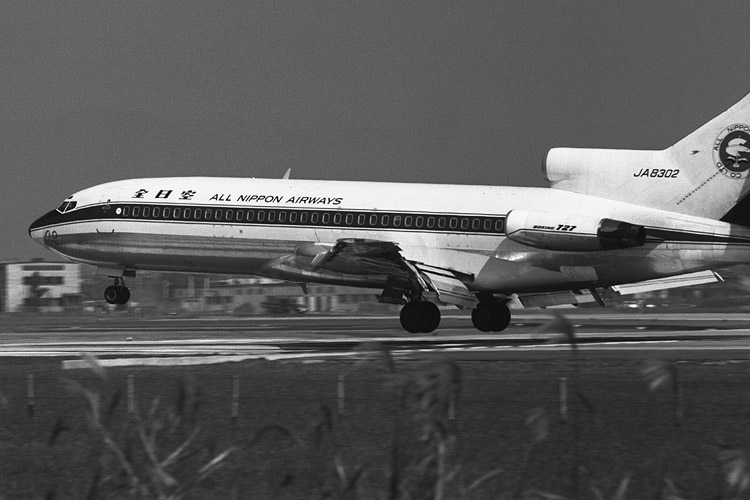
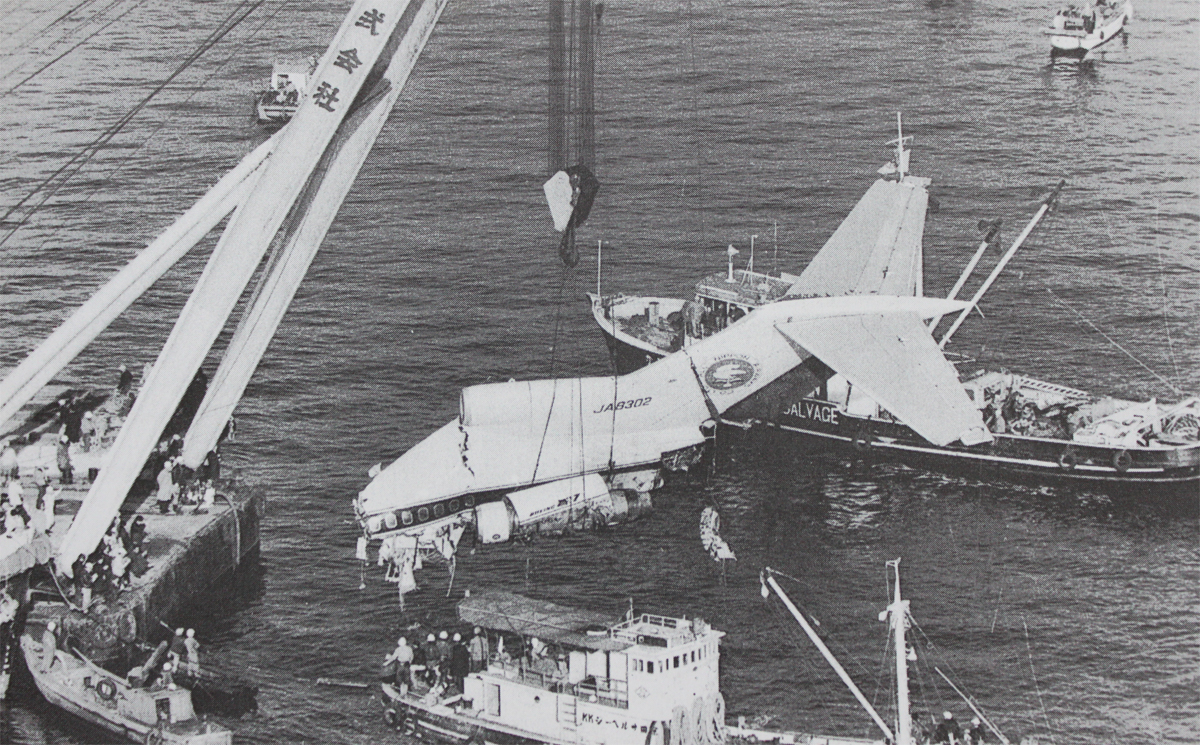
Crash of a Boeing 727-81 off Tokyo: 133 killed
Date & Time:
Feb 4, 1966 at 1900 LT
Operator:
Registration:
JA8302
Survivors:
No
Schedule:
Sapporo – Tokyo
MSN:
18822
YOM:
1965
Flight number:
NH060
Crew on board:
7
Crew fatalities:
Pax on board:
126
Pax fatalities:
Other fatalities:
Total fatalities:
133
Circumstances:
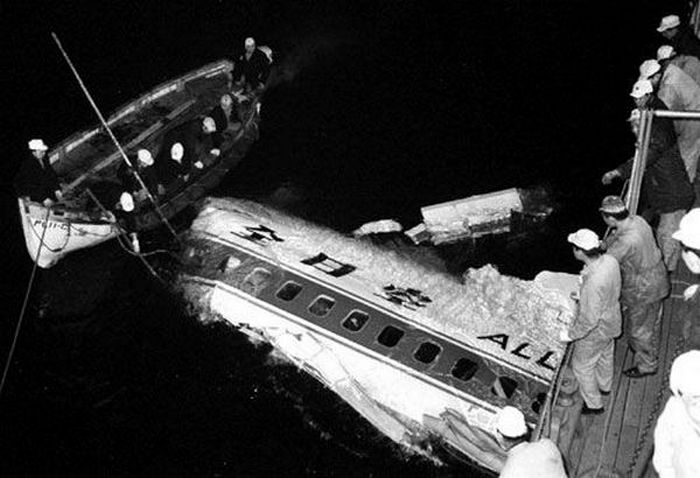
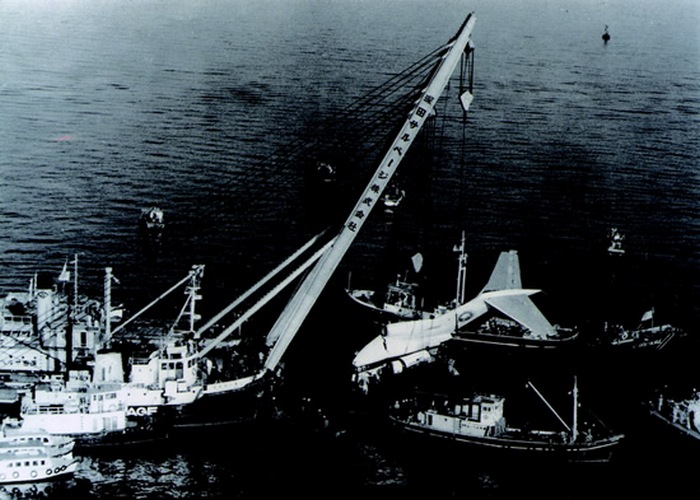
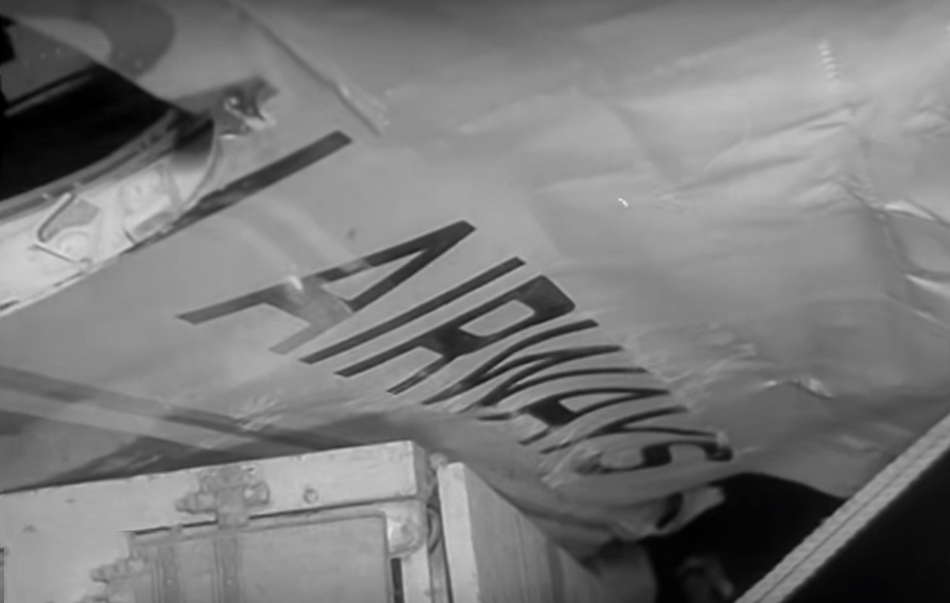
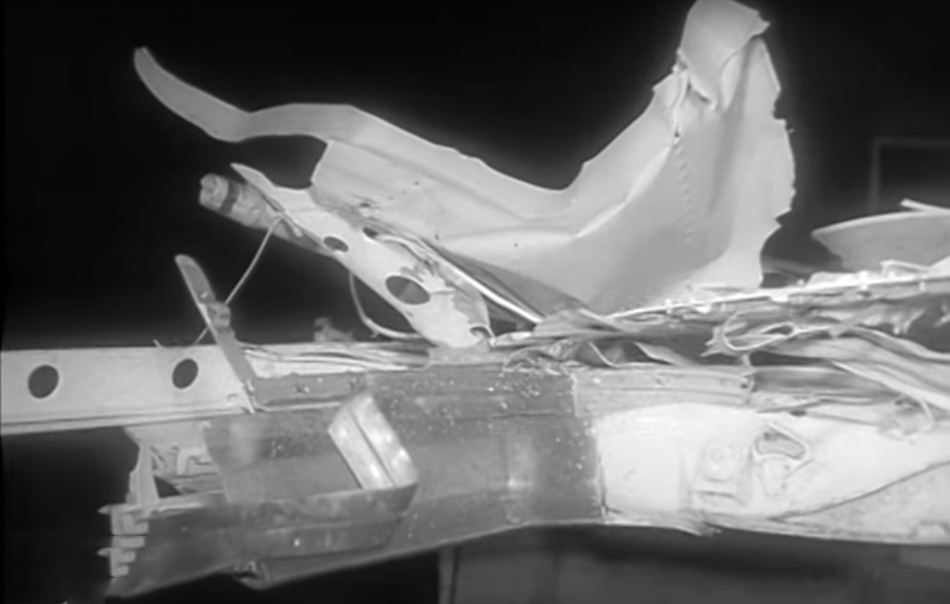
While approaching Tokyo-Haneda Airport by night and in good weather conditions, at an altitude of about 2,000 feet, the three engine aircraft went out of control and crashed into the Tokyo Bay, about 12 km southeast of the airport. Lots of debris were quickly recovered as well as the tail that sank by a depth of 20 meters. The aircraft disintegrated on impact and none of the 133 occupants survived the crash, which was the worst in Aviation History to date. At the time of the accident, the crew was approaching the airport under VFR mode in good weather conditions and did not report any issues on the frequency.
Probable cause:
The exact cause of the accident could not be determined with certainty. It was reported that the pilot was in contact with ATC during the final approach and did not report any anomalies. Investigations did not reveal any technical issues with instruments or engines or any kind of explosion prior to the accident.
Ground accident of a Douglas C-47A-25-DK in Toyama
Date & Time:
Oct 29, 1963
Operator:
Registration:
JA5024
Survivors:
Yes
MSN:
13194
YOM:
1944
Crew on board:
0
Crew fatalities:
Pax on board:
0
Pax fatalities:
Other fatalities:
Total fatalities:
0
Circumstances:
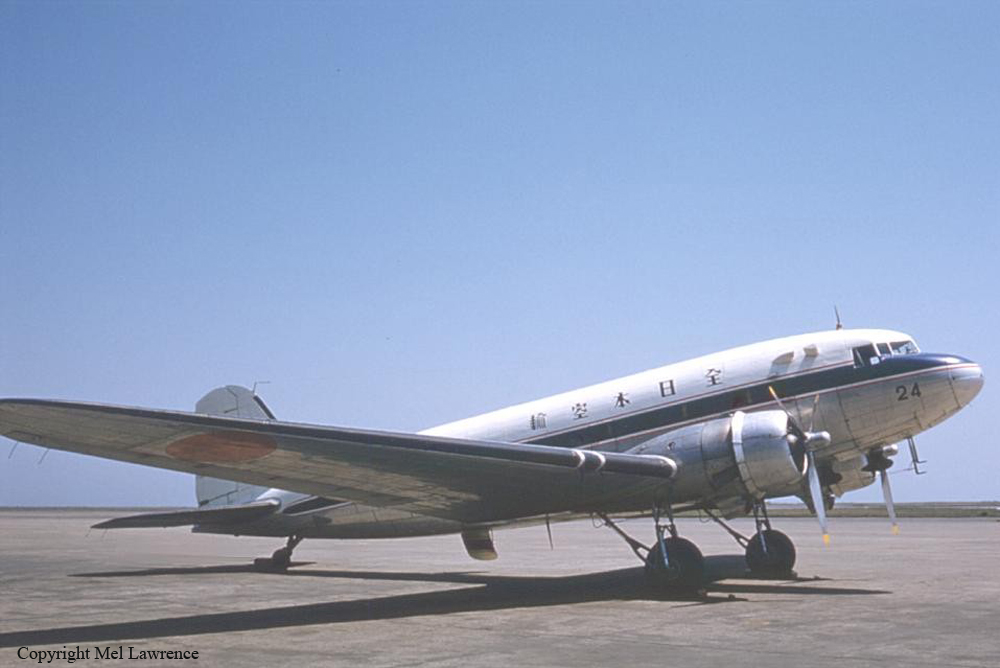
Suffered a ground accident at Toyama Airport. There were no injuries.
Crash of a Douglas DC-3A-SC13G in Sendai
Date & Time:
May 10, 1963
Operator:
Registration:
JA5040
Survivors:
Yes
MSN:
6349
YOM:
1942
Crew on board:
0
Crew fatalities:
Pax on board:
0
Pax fatalities:
Other fatalities:
Total fatalities:
0
Circumstances:
Suffered a ground accident at Sendai Airport. There were no casualties.