
Zone

Crash of a Beechcraft 1900C near Tonopah: 5 killed

Date & Time: Mar 16, 2004 at 0401 LT
Type of aircraft:
Operator:
Registration:
N27RA
Flight Type:
Survivors:
No
Schedule:
Groom Lake - Tonopah
MSN:
UB-37
YOM:
1985
Location:
Crew on board:
1
Crew fatalities:
Pax on board:
4
Pax fatalities:
Other fatalities:
Total fatalities:
5
Circumstances:
The Air Force Materiel Command Beech 1900 crashed while on a routine support mission from a remote classified airstrip on the Nellis range to the Tonopah Test Range. It departed at 03:43 for Tonopah. After reporting the runway lights in sight, the pilot configured the airplane for the approach and initiated a circling maneuver to the right for a visual straight-in approach to runway 32. During the turn the pilot suffered a sudden cardiac death. Half way through the turn the airplane began a gradual descent until it impacted the ground. The airplane broke up and burst into flames. Investigation revealed that the pilot had violated federal policy and directives, wilfully deceived flight medical examiners, suppressed significant medical information and ingested inappropriate medications for a deteriorating and dangerous health condition. The pilot had high blood pressure and failed to report it, and denied taking medications to his Federal Aviation Administration flight physical examiners.
Probable cause:
The pilot became incapacitated during his approach to land due to sudden cardiac death.


Crash of a Beechcraft C99 Airliner near Bishop: 1 killed

Date & Time: Feb 12, 1999 at 1030 LT
Type of aircraft:
Operator:
Registration:
N205RA
Flight Phase:
Flight Type:
Survivors:
No
Site:
Schedule:
Tonopah - Bishop
MSN:
U-205
YOM:
1983
Crew on board:
1
Crew fatalities:
Pax on board:
0
Pax fatalities:
Other fatalities:
Total fatalities:
1
Captain / Total flying hours:
2958
Captain / Total hours on type:
692.00
Aircraft flight hours:
20522
Circumstances:
The airline transport pilot was repositioning the Beech C99 turboprop cargo hauler on a 73-mile trip without cargo. The pilot had been flying this route for some time and this was his last trip before upgrading to a larger aircraft and route. He told friends that he would take pictures of the scenic parts of the route on his last trip. Three witnesses reported seeing the airplane flying west at low altitude. Two of the witnesses were local ranchers who saw the airplane enter the White Mountains near Trace Plumas Canyon about 7,000 to 8,000 feet msl. White Mountain is 14,246 feet, tapering off north to 13,559 feet and south to 11,285 feet msl. The airplane was reported missing and 2 days later located on White Mountain about 9,400 feet msl. The company flight planned route is 15 miles south of the accident site through Westgard Pass, about 7,291 feet msl. Examination of the low energy impact and the subsequent recovery inspection failed to reveal any mechanical issues.
Probable cause:
The pilot's failure to follow procedures and directives and his failure to maintain clearance from mountainous terrain.
Final Report:

Crash of a Cessna 414 Chancellor in Tonopah: 2 killed

Date & Time: Sep 29, 1981 at 1245 LT
Type of aircraft:
Operator:
Registration:
N5404G
Flight Type:
Survivors:
No
Schedule:
Tonopah - Tonopah
MSN:
414-0956
YOM:
1977
Location:
Crew on board:
2
Crew fatalities:
Pax on board:
0
Pax fatalities:
Other fatalities:
Total fatalities:
2
Captain / Total flying hours:
1743
Captain / Total hours on type:
20.00
Circumstances:
The crew was engaged in a local training flight at Tonopah Airport. While initiating a go-around manoeuvre, the pilot-in-command lost control of the airplane that entered an uncontrolled descent and crashed. Both occupants were killed.
Probable cause:
Uncontrolled collision with ground during a go-around after the pilot failed to maintain flying speed. The following contributing factors were reported:
- Local instructional and pilot qualification checkout with simulated se training,
- Pilot-in-command presumed at controls.
Final Report:

Crash of a Douglas C-47-DL in Tonopah

Date & Time: Aug 19, 1964 at 2005 LT
Operator:
Registration:
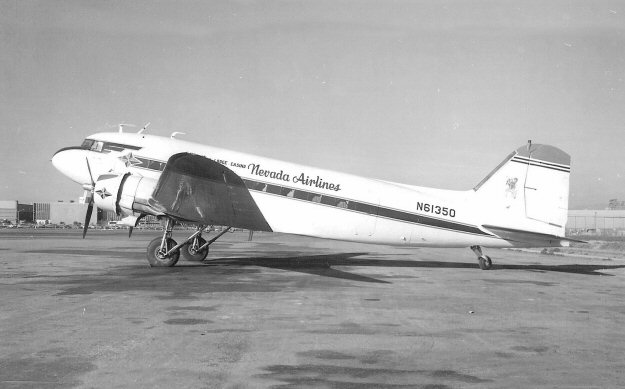
N61350
Survivors:
Yes
Schedule:
Burbank – Hawthorne
MSN:
4535
YOM:
1942
Flight number:
HNA707
Location:
Crew on board:
3
Crew fatalities:
Pax on board:
32
Pax fatalities:
Other fatalities:
Total fatalities:
0
Aircraft flight hours:
8209
Circumstances:
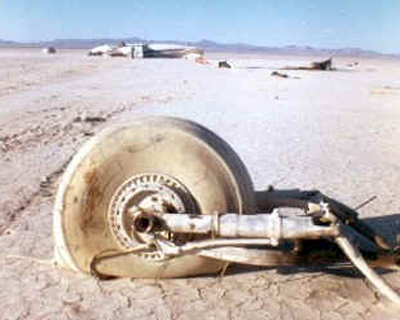
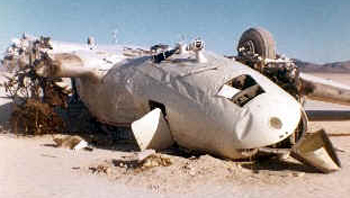
The DC-3 was cruising at FL115 between Burbank and Hawthorne when a no. 2 engine failure forced the crew to shut the engine down and feathered the propeller. At 20:50 EDT the crew radioed Tonopah, NV and said they wanted to make an emergency landing there. At 20:58 EDT the no. 1 engine lost power. The propeller couldn't be feathered and an emergency glide was initiated towards Mud Lake airfield. A 2000 feet/min rate of descent was necessary to maintain a 110 knots airspeed. All electrical and hydraulic power was lost during the descent. The DC-3 struck the ground in a 10-20 degree nose down attitude during the flareout and overturned. It appeared that there were numerous maintenance irregularities, a.o. improperly adjusted valve clearances, improperly adjusted voltage regulators and improperly installed cylinders. The plane was equipped with 2 28V dc generators and one 12V battery. All electrical components other than the starters were designed for 12V dc operation. It also appeared that all maintenance was performed by companies other than the operator. In many instances inadequate and incomplete records failed to reflect work accomplished.
Probable cause:
In flight failure of both engines caused by a fatigue failure on the right engine No.12 cylinder and failure of the left front master rod bearing, necessitating a night emergency landing on unlighted terrain. Inadequate maintenance and inspection.

Crash of a Douglas UC-67 Dragon in Loon Lake

Date & Time: Jan 29, 1943
Type of aircraft:
Operator:
Registration:
39-52
Flight Phase:
Flight Type:
Survivors:
Yes
Schedule:
Tonopah – McChord
MSN:
2738
YOM:
1939
Location:
Crew on board:
8
Crew fatalities:
Pax on board:
0
Pax fatalities:
Other fatalities:
Total fatalities:
0
Circumstances:
The airplane went down at Loon Lake (elevation 5,280 feet) with eight men aboard. The plane was returning to McChord AFB, Washington from a training mission in Nevada when it flew into a heavy snow storm near Pendleton, Oregon. Unable to maintain altitude, the pilot, Robert R. Orr, decided to attempt a landing in Boise. The approach was hampered by heavy icing and a failed radio. An order to prepare to parachute was given at 13,000 feet. Just then a hole developed in the cloud cover. A frozen lake was spotted and a landing was attempted. Frozen flaps caused the first approach to be abandoned. In a successful second approach, the plane touched down on the frozen lake, sliding across the ice and through the trees. With both wings sheared off, the plane came to rest 150 feet from the shore of Loon Lake in the timber. All eight men survived. A broken kneecap was the only injury. After waiting five days for rescue, the crew selected three men to go for help. On February 3rd, the three left Loon Lake with a shotgun and chocolate rations. They followed the Secesh River downstream. Then, hiking over Lick Creek Summit, elevation 6,700 feet, they reached the Lake Fork Guard Station. Once inside, an exhausted crew member picked up the telephone and spoke to the operator in McCall. The three men had hiked for 14 days and approximately 42 miles through waist deep snow. On February 18th, the wreckage was spotted by bush pilot, Penn Stohr, of Cascade, Idaho. He returned and notified authorities. Stohr made two more flights, landing on the frozen lake to fly the crew out. After some 21 days in the harsh winter climate of Idaho’s primitive area, all eight men were rescued.
Source: https://www.secesh.net/B23.htm
Probable cause:
Snowstorm, icing and radio failure.